Few things trip up emerging (and even experienced) screenwriters like phone calls. Not because they’re complicated in real life (they’re a daily occurrence!) but because the moment a call enters a screenplay, writers start second‑guessing everything: Do I need INTERCUT? Should I use (O.S.) or (V.O.)? What if we hear both sides? What if we don’t? What if the call cuts between locations?
So, how DO you format phone calls in a screenplay?
Well, the good news is that phone calls are not mysterious. The bad news is that scripts are full of unnecessary formatting flourishes that distract from the story. In 2026, industry readers aren’t looking for clever formatting. They’re looking for clarity, efficiency, and storytelling momentum.
In today’s blog, we’ll break down exactly how to format phone calls in a screenplay, when to use each method, and how to avoid the most common mistakes so your reader never gets confused, irritated, or pulled out of the story.
Table of Contents
- Phone Calls in a Screenplay Explained
- The 3 Ways to Format a Phone Call in a Screenplay in 2026
- When to Use Split-Screen Formatting for Phone Calls
- Phone Call Format Checklist for Writers
- Famous Movie Phone Calls (with Format Examples)
- FREE Phone Call Template (PDF Download)
- FAQ About Phone Calls in Screenplays
- Conclusion

Phone Calls in a Screenplay Explained
Before we get into formatting, it’s worth stating something plainly: a phone call is just a conversation. The formatting should serve comprehension, not call attention to itself. If the reader understands who is speaking, where we are, and whether both sides are heard, you’ve already won.
Most phone calls also do not need a full dramatic ramp‑up. We don’t need a greeting unless the greeting matters. “Hello?” is character, pacing, and tone rather than mandatory realism.
If the call begins mid‑conversation, that’s allowed. If it starts with a disconnected voicemail, great. If someone calls, listens, and hangs up without speaking, that’s storytelling too.
Once you’re clear on what the call is doing for the scene, choosing the right formatting method becomes much easier.
Format phone calls instantly with Celtx’s automated formatting tools. Try it today for free!
The 3 Ways to Format a Phone Call in A Screenplay 2026
There are three accepted, industry‑standard ways to handle phone calls in a screenplay. None of them are “better” than the others; they simply serve different narrative purposes.
Method 1: The One-Sided Conversation (Dialogue only)
Debated by writer John August, the one-sided conversation is the most common, and often the most effective approach. We stay with one character and only hear what they say. The other person exists purely in subtext.
This method is ideal when:
- The emotional point of view is anchored to one character
- The unheard voice is less important than the reaction
- You want the audience to infer information, tension, or stakes
For example:
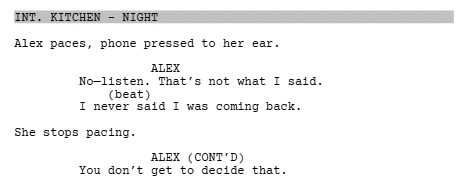
Notice there’s no special formatting beyond dialogue. No (O.S.). No INTERCUT. The scene works because the missing half of the conversation creates pressure. The reader fills in the blanks, which is almost always more engaging than spelling everything out.
If you only need one side of the call, this should be your default choice.
Method 2: The Intercut (Standard Industry Practice)
INTERCUT is for when we actively move between locations and hear both sides of the conversation. It’s clean, readable, and still the preferred industry standard in 2026 when used properly.
This method works best when:
- Both characters are emotionally or narratively important
- The rhythm of back‑and‑forth matters
- The locations add contrast or story information
Let’s see it in action:

The key here is to only use INTERCUT once, then let the dialogue flow. Do not repeat location headers. Do not re-announce the intercut every few lines. The reader understands what’s happening.
Also, only intercut when both spaces matter. If one location doesn’t add meaning, you’re better off staying with a single POV.
Method 3: Using Character Extensions (O.S. and V.O.)
Character extensions are often misunderstood, especially with phone calls. In 2026, their use is more defined than ever.
- (O.S.) – Off Screen: the character is physically nearby but not visible
- (V.O.) – Voice Over: the voice is not part of the immediate physical space
For phone calls, (V.O.) is generally correct when we hear the person on the other end.
For example:

This method is particularly useful when:
- One character is clearly dominant in the scene
- The call is brief or functional
- You want to avoid full intercutting
Avoid mixing this with INTERCUT and choose one approach per call; consistency helps the reader trust you.
When to Use Split-Screen Formatting for Phone Calls
Split screens are stylistic choices rather than formatting obligations. If the script explicitly intends a simultaneous visual presentation: two frames on screen at once, it’s appropriate to signal that.
This is rare, but valid, especially in comedies, thrillers, or heightened stylistic projects.
Just like this:

Because split screens affect production and direction, you should only specify them if they are essential to the storytelling. Otherwise, let the director decide.
Phone Call Format Checklist for Writers
Before locking your script, run through this quick mental checklist.
- Does the audience need to hear both sides of the call? If not, stay with one character.
- Does changing location add story value? If yes, consider an intercut. If no, don’t.
- Are you consistent in your formatting choice from start to finish? Switching methods mid-call is a red flag.
You don’t need fancy formatting to sound professional. You need readability, intention, and restraint.
Famous Movie Phone Calls (with Format Examples)
One of the fastest ways to sanity‑check your phone‑call formatting is to look at how professional screenwriters handle it when the stakes are high. The reassuring truth? Even in iconic films, phone calls are formatted plainly. What makes them memorable is context and character, not technical cleverness.
Let’s walk through a few well‑known examples and what they teach us.
Intercut Calls | The Social Network (2010)
Aaron Sorkin’s scripts are often dialogue‑heavy, but when phone calls matter structurally, he uses clean intercuts. In The Social Network, intercut calls are used during negotiations and confrontations where both sides are intellectually active.
Rather than dumping exposition into one character’s mouth, Sorkin shifts between locations to keep momentum sharp and the power dynamic visible.


Both Cox and the student are making decisions in real time. The audience needs access to each side’s intentions.
Emotional Compression | Manchester by the Sea (2016)
Kenneth Lonergan frequently uses phone calls to compress emotional distance into seconds. In Manchester by the Sea, calls related to family logistics and loss are handled with extreme restraint.
Typically, we remain with one character in a private space. The dialogue is minimal. The emotional weight lands in pauses, unfinished thoughts, and what the character does after the call ends.

Here we have one‑sided conversation with no intercutting or special notation beyond dialogue. The script prioritizes aftermath over exchange. The call is incidental; the reaction is the scene.

Deadpan and Functional | Fargo (1996)
The Fargo screenplay uses phone calls almost aggressively plainly. Characters call to exchange information, make arrangements, or issue threats, but the formatting never editorialises.
Often, the call is written in a single stream of dialogue with no embellishment, even when the content is dark or absurd.

The formatting focuses on dialogue only, often without even naming the phone explicitly if the action makes it clear. The neutrality of the formatting mirrors the film’s tonal contrast of horrific events presented with casual calm.
Check out Myer’s Movie Moments for more of the best phone call scenes around:
FREE Phone Call Template (PDF Download)
Before locking your script, run through our downloadable checklist. Because switching methods mid‑call is a red flag.
You don’t need fancy formatting to sound professional. You just need readability, intention, and restraint.
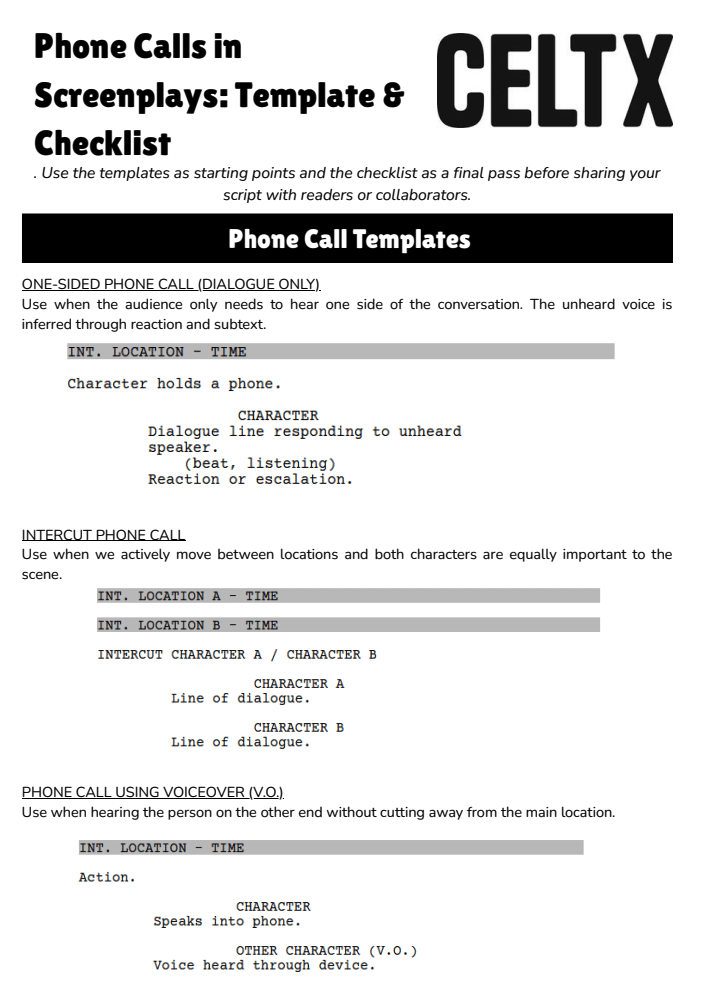
Download our free phone call template and checklist to ensure you’re consistent every single time in every single script!
FAQ About Phone Calls in Screenplays
No. If it’s obvious from context or action, don’t clutter the script with redundant information.
No. It’s still widely used and accepted in 2026, just often overused.
Only if both sides actively serve the scene.
Absolutely. Scripts don’t owe realism; they owe momentum.
Over‑formatting. If the reader notices your formatting, it’s probably doing too much.
Conclusion
Phone calls don’t need to be flashy to be effective. In fact, the best‑formatted phone calls are usually the ones the reader barely notices at all. Whether you choose a one‑sided conversation, a clean intercut, or a simple (V.O.) extension, the goal remains the same: serve the story, respect the reader, and keep the page moving.
If you can do that, your phone calls will feel effortless, and effortless is exactly what industry readers are hoping for.
Focus on your story, not your formatting.
Let Celtx’s Script Editor automatically apply all industry rules while you focus on the story.
Up Next:
How to Write Scene Transitions: A Guide for Screenwriters
Learn how to write seamless scene transitions in your screenplay with practical tips, techniques, and examples to elevate your storytelling.