Loglines have a terrible reputation. They’re either treated like sacred spells you have to get perfect or dashed off at the last minute as some vaguely dramatic sentence you hope no one reads too closely. In reality, loglines are neither mystical nor optional. They’re a working tool, and when they work, they work hard.
A good logline should make someone want to read your script, show you understand your own story, and signal tone, genre and stakes in seconds
A bad one does the opposite. It confuses, overwhelms, or tells us everything except why we should care.
So, in today’s blog, we’re going to cut through the noise. We’ll break down 10 logline examples that genuinely work, across different genres, and explain why they work so you can apply the same thinking to your own project.
So, let’s get started.
Table of Contents
- What is a Logline?
- 10 Logline Examples and Why They Work
- Simple Formula for Writing Your Own Logline (Logline Math)
- Free Professional Logline Formula Sheet (Download)
- Common Logline Mistakes That Lead to a “Pass” Rating
- Quick Logline Checklist: Audit Your Pitch in 60 Seconds
- Frequently Asked Questions (FAQ) About Logline Examples
- Conclusion

What is a Logline?
A logline is a one- or two-sentence summary of your story’s core engine: the protagonist, the central problem, what they’re trying to achieve, and what’s at stake if they fail.
It is not:
- A synopsis
- A theme essay
- A list of things that happen
If you want a full breakdown (including how loglines are actually used by the industry), we’ve covered that in depth in our cornerstone guide: How to Write a Logline that Sells.
For now, think of a logline as your story under pressure. Strip it back far enough, and what’s left should still feel alive.
10 Logline Examples and Why They Work
Below are ten loglines that actually do what a logline is supposed to do. They span different genres and formats but every one of them is clear, specific, and purposeful.
As you read, don’t just take note of what they say. Pay attention to what they leave out, how quickly they establish conflict, and how much story they suggest without overexplaining.
1. Die Hard
When a New York cop visits his estranged wife in LA, he becomes the only thing standing between a group of terrorists and dozens of hostages trapped in a skyscraper.
This logline is doing several things at once without feeling busy. We get character (estranged husband), situation (wrong place, wrong time), conflict (terrorists), and stakes (hostages).
Crucially, it frames the personal inside the spectacle. What we need to remember is that this isn’t just an action movie but about a man trying to fix his life while everything explodes around him.
2. Get Out (2017)
A young Black man visits his white girlfriend’s family estate, where his growing unease reveals a horrifying conspiracy beneath their polite liberal facade.
The brilliance here is escalation. We start grounded and social, then slide into horror without explaining the twist. It promises discomfort, specificity, and menace.
Note how the logline doesn’t explain the mechanics of the horror but also it sells the experience of it.
3. Ladybird
A fiercely independent teenager navigates her final year of high school while struggling with her turbulent relationship with her mother.
This logline understands that not every story needs a “high concept” hook. It tells us exactly what we’re watching and trusts the emotional specificity to do the heavy lifting.
4. Parasite (2019)
Greed and class discrimination threaten the newly formed symbiotic relationship between a wealthy family and the destitute clan who infiltrates their household.
This works because it frames the story as a relationship rather than a plot. The word “symbiotic” is doing clever thematic work, and the conflict is rooted in class and the twists.
5. Jaws (1975)
A local sheriff, a marine biologist, and an old seafarer must stop a great white shark from terrorising a seaside town.
Clear goal. Clear threat. Clear team-up. It also implies escalating danger without spelling out the body count. We don’t need to know anything else; the simplicity and stakes draw us in completely

6. Fleabag (2016-2019)
A dry-witted woman navigating grief, guilt, and modern dating repeatedly sabotages her own happiness while breaking the fourth wall to confide in the audience.
Tone is everything here. You can hear the voice. It sells the show as much on how it’s told as what it’s about, which is exactly what a strong TV logline should do.
7. Children of Men (2006)
In a bleak future where humans have lost the ability to reproduce, a disillusioned bureaucrat is tasked with protecting the world’s only pregnant woman.
This successfully combines high concept with clean execution. The world-building is implied, not explained, and the human focus anchors the scale to one problem and one objective with enormous consequences.
8. Manchester by the Sea (2016)
After the death of his brother, an emotionally withdrawn man becomes guardian to his teenage nephew, forcing him to confront a past trauma that drove him from his hometown.
Notice how the logline points backward and forward. We understand what the story will dig into without being told the trauma itself. Restraint is the key here and works wonderfully.
9. The Bear (2022-Present)
A fine-dining chef returns home to run his late brother’s failing sandwich shop, where chaos, grief, and family tensions threaten to pull him apart.
This grounds an intense show in a single, relatable problem. It also promises pressure, speed, and emotional conflict without explaining the kitchen dynamics in detail.
10. Her (2013)
A lonely writer in the near future falls in love with an operating system designed to meet his every emotional need.
Concept first, emotion immediately after. It invites curiosity and discomfort, and it doesn’t apologise for the weirdness.
Check out more awesome loglines on IMDb.
Simple Formula for Writing Your Own Logline (Logline Math)
There’s no single formula that magically produces a perfect logline, but there is a structure that helps you cut through noise and get to the heart of your story quickly. Think of this less as a rule and more as a scaffolding you can remove once the shape is sound.
A reliable starting point looks like this:
When [a specific protagonist] faces [a clear problem or inciting incident], they must [take decisive action] before/otherwise [the stakes].
This works because it forces you to answer four essential questions:
- Who is the story about?
- What disrupts their world?
- What are they actively trying to do?
- Why does it matter if they fail?
If any of those are missing, the logline almost always feels flat or incomplete. Let’s break it down:
Step 1 | A Specific Protagonist
Avoid generic labels where possible. “A man” or “a woman” is rarely as compelling as a defining trait or situation. You don’t need a full character biography — just the detail that places them in the story’s pressure cooker.
Step 2 | A Clear Problem
This is the engine of the story. Not the theme. Not the backstory. The disruptive force that makes the film exist at all.
Step 3 | An Active Goal
What does the character do in response? If the protagonist isn’t making choices, the story won’t move, and the logline will feel passive.

Step 4 | Meaningful Stakes
Stakes don’t have to be global or explosive, but they do have to be specific. Emotional fallout, moral compromise, loss of identity, physical danger, all of these count.
A Few Practical Logline Examples
Do you recognise these?
When a grieving chef returns home to take over his brother’s failing restaurant, he must confront family tensions and his own burnout before the business, and he, collapse.
When a young woman’s car breaks down, she’s forced into an uneasy reunion with the father who abandoned her, risking the truth she’s spent years avoiding.
When humanity can no longer reproduce, a disillusioned bureaucrat must protect the world’s only pregnant woman before hope for the future is extinguished.
Notice how each example prioritises clarity over cleverness. Voice can be refined later; the structure needs to hold first.
Free Professional Logline Formula Sheet (Download)
Distilling your 120-page screenplay into a single, high-concept sentence is a mathematical challenge as much as a creative one.
To help you master the professional ratios of a pitch that lands, we’ve created a portable Logline Formula Sheet. This one-page reference allows you to ‘plug in’ your protagonist, conflict, and stakes to ensure your story’s irony and urgency are impossible for producers to ignore. Download your copy below to use as a roadmap for your next project.
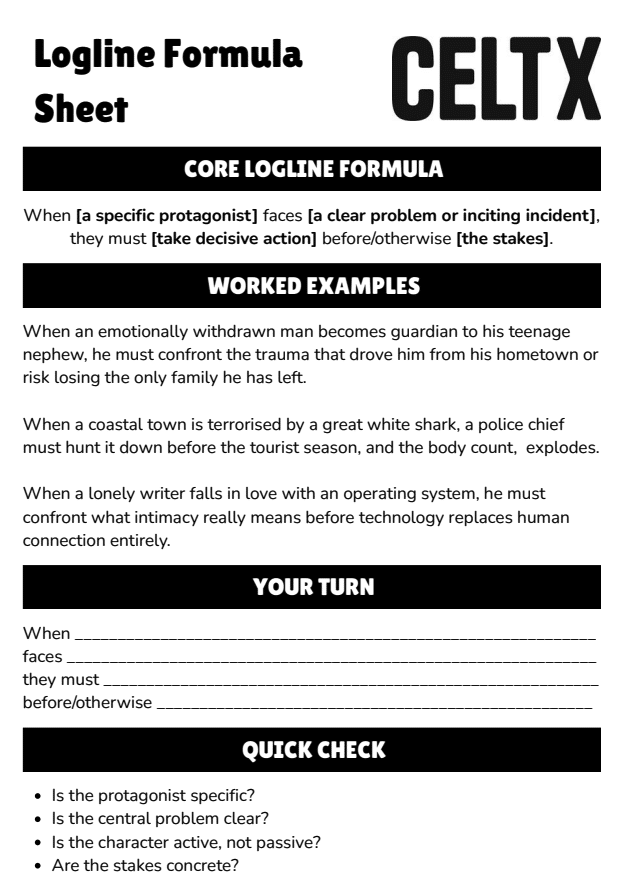
Click here to download the Celtx Logline Formula Sheet
Common Logline Mistakes That Lead to a “Pass” Rating
Most weak loglines fail because the focus is slightly off. The mistakes below are incredibly common, even in otherwise strong projects, and they usually come from trying to be too clever, too subtle, or too exhaustive in a space that demands clarity above all else.
Think of this section not as a list of rules you’ve broken, but as a set of pressure points worth checking. Fix these, and even a rough logline can start pulling its weight fast.
1. Being Vague Instead of Specific
Vagueness often masquerades as intrigue. Phrases like “unexpected events unfold”, “secrets come to light”, or “everything changes” sound dramatic but tell us nothing. Specifics are what create interest. A reader can handle limited information; what they can’t engage with is uncertainty about what the story actually involves.
If your logline could describe five different scripts you’ve read this year, it’s too broad.
2. Listing Plot Beats
Many loglines try to summarise what happens instead of clarifying what drives the story forward. This usually results in sentences packed with incident but lacking purpose. A logline isn’t a highlights reel — it’s a stress test. Focus on the central problem that propels the story from beginning to end, not the sequence of events that decorate it.
If you remove one beat and the logline collapses, you’re on the right track. If it still works, you’re probably describing atmosphere rather than conflict.
3. Burying (or Avoiding) the Protagonist
A surprising number of loglines don’t clearly identify who the story is about. Phrases like “a series of events,” “a group must,” or “a town is shaken” sidestep character. But story works because we experience change through someone specific.
Even ensemble pieces benefit from anchoring the logline in one clear perspective. If we don’t know whose journey we’re following, emotional investment never has a chance to form.
4. Explaining the Theme
Themes are important. When a logline leans too hard into ideas like grief, identity, masculinity, love, or forgiveness, it often becomes abstract. Readers don’t connect to concepts; they connect to people under pressure.
Your theme will emerge through the situation you describe. Trust the story to carry it.
5. Overstuffing the Sentence
Trying to “get everything in” is one of the fastest ways to kill momentum. Multiple locations, backstory clauses, subplots, and tonal qualifiers quickly turn a logline into something heavy and unreadable.
A good rule of thumb: if you need more than one “and” or “while” the logline probably isn’t ready yet.
6. Hiding the Stakes
Some loglines describe the setup beautifully but stop just short of telling us why it matters. What happens if the protagonist fails and doesn’t develop? What is genuinely at risk: emotionally, physically, socially, or morally?
Stakes don’t need to be world-ending, but they do need to be clear. Without consequence, there’s no urgency.
7. Chasing Cleverness Over Clarity
Wordplay, irony, and tonal flair have their place, but clarity still comes first. If a clever phrase obscures the story engine, it’s working against you. A logline isn’t the place to impress someone with your vocabulary or with how “different” the project is.
Once the logline works cleanly, then you can polish the voice.
Write your logline and start your script in Celtx for free.
Quick Logline Checklist: Audit Your Pitch in 60 Seconds
Before you share your logline, ask:
- Do we know who the story is about?
- Is the central conflict clear?
- Can we picture the film or series?
- Does the tone match the genre?
- Would you want to read this script?
If the answer isn’t a confident yes, then there’s more work to do.
Frequently Asked Questions (FAQ) About Logline Examples
Reading professional examples helps you internalize the math of a great pitch. It allows you to see how successful writers use irony and high-stakes obstacles to create an itch the reader has to scratch. By studying award-winning examples, you learn to spot when your own logline is missing a crucial variable, like a clear goal or a tangible price of failure.
In 2026, the most reliable databases for genuine, professional loglines are The Black List, Script Slug, and SimplyScripts. While streaming platforms like Netflix provide marketing blurbs, these often withhold information to build curiosity for viewers. For writers, it is better to study “producer loglines” that explicitly reveal the main conflict and protagonist’s goal.
Absolutely. In fact, one of the best exercises for a new writer is to find a film with a similar concept to theirs and try to reverse-engineer its logline. If your story is “Jaws in a supermarket,” studying the Jaws logline helps you identify exactly how to frame your “Big But” (the central obstacle) to ensure your stakes feel galactic rather than slight.
A logline is a sales tool that describes the story (e.g., “A shark terrorizes a beach town”). A tagline is a marketing tool that describes the feeling or vibe (e.g., “You’ll never go in the water again”).
When searching for examples to help your writing, ensure you are looking at loglines, as taglines provide zero structural information for your script.
Conclusion
A logline isn’t about sounding impressive but about clarity. When you can express your story’s engine in one clean sentence, writing, rewriting, and pitching all become easier. It shows you understand your own material and gives other people confidence in it too.
If your logline feels hard to pin down, step back, simplify, and keep asking what the story is really about. Read more logline examples to understand what makes successful ones work.
Get clear first and polish later.
Focus on your story, not your formatting.
Let Celtx’s Script Editor automatically apply all industry rules while you focus on the story.
Up Next:
How to Write a Logline that Sells: Step-by-Step Guide
You have the inspiration — now master the implementation. Dive into our deep-dive guide on the professional step-by-step process of writing a logline that survives the Hollywood slush pile.