You’ve built an immersive world and outlined a compelling plot, but the moment your characters open their mouths, the magic disappears. Ouch.
Nothing marks an amateur script faster than dialogue that sounds written rather than spoken.
Audiences today crave authenticity and lived experience, and wooden dialogue is an instant script-killer.
Unlike prose, where narration can fill in the gaps, screenwriters must rely on the economy of the spoken word and the power of subtext. If your characters sound like they are reading from a manual or explaining the plot to each other, your script is likely headed for the “Pass” pile.
This guide will help you diagnose exactly why your dialogue feels off and provide ten actionable fixes to make your characters sound undeniably real.

What Makes Screenplay Dialogue Sound Fake?
Dialogue sounds fake when it lacks resistance and agenda.
In the real world, people rarely say exactly what they mean or give perfectly structured information. Fake dialogue usually suffers from On-the-Nose syndrome (stating feelings directly), excessive small talk, or serving as a Basil Exposition (Austin Powers) mouthpiece for the writer rather than a voice for the character.
In my experience, the #1 reason dialogue fails is because the writer is using the characters to talk to the audience instead of to each other. If your characters are explaining things they both already know — the “As you know, Bob” trap — the immersion snaps instantly.
In film, where visuals will always dominate, any accompanying dialogue must be deliberate and impactful. Dialogue is the bridge between what’s seen on screen, and what’s felt.
The ultimate question is, of course, how do we achieve that balance? Get ready for our ten top tips…
10 Professional Fixes for Flat Script Dialogue
Fix 1: Kill the Exposition Dumps
Exposition is necessary but delivering it through unnatural dialogue can be jarring. Characters shouldn’t speak solely to inform the audience. Characters shouldn’t speak solely to inform the audience.
Before

The Fix: Weave information into action or conflict. Let characters argue about the facts.
After
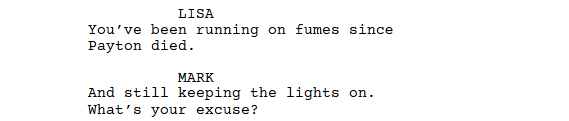
Fix 2: Capture unique character voices
If you cover the character names and can’t tell who is speaking, your characters sound the same.
The Fix: Capture unique character voices by adjusting cadence and vocabulary based on background.
Example:

Notice how these characters have their own distinct way of talking, making it easy for the audience to differentiate them, even without visual cues.
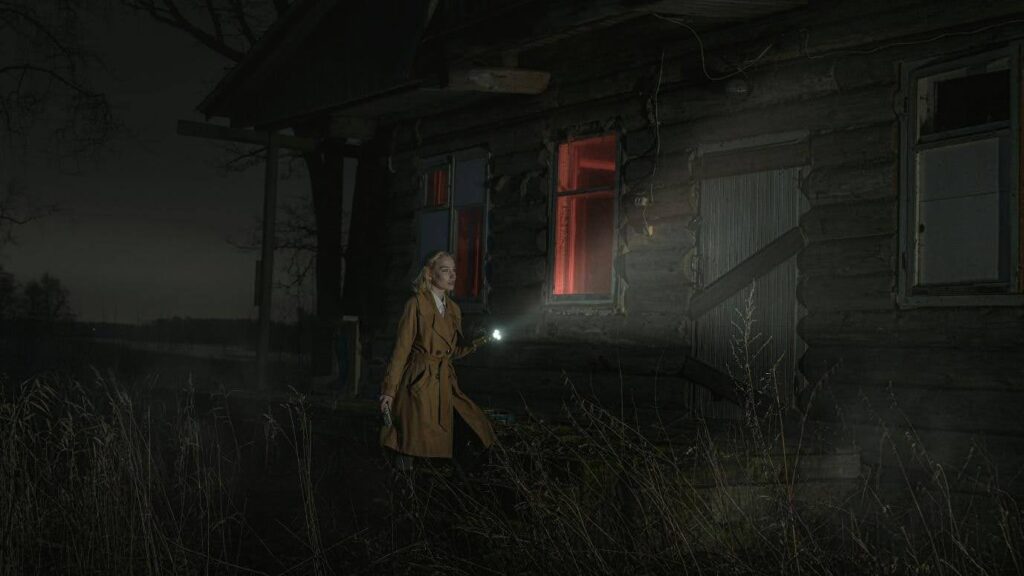
Fix 3: Submerge Your Subtext
Real power comes from what isn’t said.
The Fix: Use subtext to imply feelings. Let characters dodge, deflect, and disguise their true motives.
Before:

After:

The second line of dialogue, including the subtext, conveys anger and disappointment without spelling it out, leaving room for the audience to interpret. Ideally, you want your audience to be fully immersed in your story, and subtext is one way to make this happen.
Fix 4: Disrupt Monotonous Rhythm
Good dialogue mirrors the natural ebb and flow of conversation.
The Fix: Vary sentence length and pacing. Use short, choppy lines for tension and longer, flowing lines for reflection.
Before:

After:

Fix 5: Eliminated Stilted Formalism
Inspiration can come simply from being out and about in our daily lives. Observe how people talk in real life. Notice the interruptions, pauses, and filler words like “um” or “you know.”
Screenplay dialogue is “life with the uninteresting parts cut out.”
The Fix: Listen to real conversations. Notice the interruptions and pauses
Simple

Elevated

Fix 6: Prune Your Slang
Slang can ground a story, but overusing it makes a script feel dated or stereotypical.
The Fix: Use slang sparingly and ensure it fits the character’s specific age, era, and personality.
For example, a teenager may say:

But you want to avoid going too far and writing:

Fix 7: Anchor Words in Background
A character’s syntax reveals their upbringing and culture.
The Fix: Consider the character’s history. A wealthy CEO and a working-class mechanic should not share a vocabulary.
Wealthy CEO

Working-Class Mechanic

Fix 8: Stop the Talking Heads
Relying solely on dialogue can make a scene feel static and uncinematic.
The Fix: Use action to break up dialogue. Physical movement adds layers and creates a dynamic scene.
Without Action
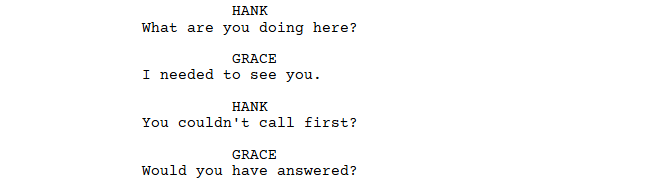
While this exchange is fine, we don’t get a huge sense of what’s happening on screen. Let’s add in some action.
With Action
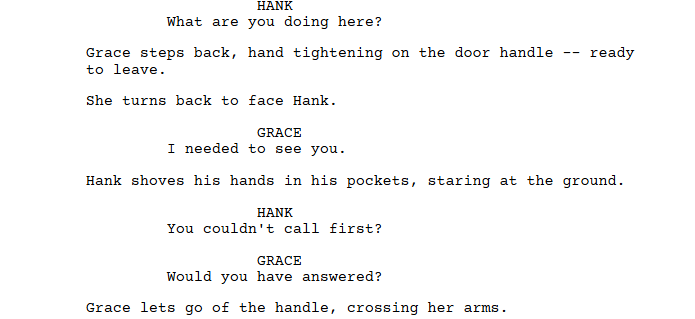
Physical action like this adds layers to the dialogue, creating a more dynamic scene.

Fix 9: Identify “Unspeakable” Lines
Screenplays are designed for performance.
The Fix: Ask yourself three questions
- Does this sound like real speech?
- Does it suit the character’s voice?
- Can the actor deliver this line naturally?
You can then refine and revise your dialogue depending on your answers. Don’t worry if you get it right the first time; writing is an ongoing process – there’s always room for improvement.
Fix 10: Edit Ruthlessly for Purpose
Great dialogue is the result of meticulous cutting.
The Fix: Cut anything that doesn’t serve the story or reveal character.
Original:

Notice this dialogue is quite long-winded for someone asking another to go to the park. While we do want to use varied sentence length and convey character, this line is in danger of frustrating an audience – it doesn’t do anything to push the action forward.
Edited

This version is punchier and easier for actors to deliver.
Masterclass Examples: Authentic Dialogue in Action
Here are some wonderful examples of dialogue exchanges that we can learn a great deal from!
Pulp Fiction (1994)
“Good dialogue reveals characters through conversation, not exposition.”
Quentin Tarantino
Jules Winnfield and Vincent Vega’s banter is iconic. It feels authentic and layered. This example: their opening discussion about “a Royale with Cheese” is both humorous and reveals their dynamic while grounding the story in a specific cultural context.
Check out a clip of the exchange below, with the script version alongside.
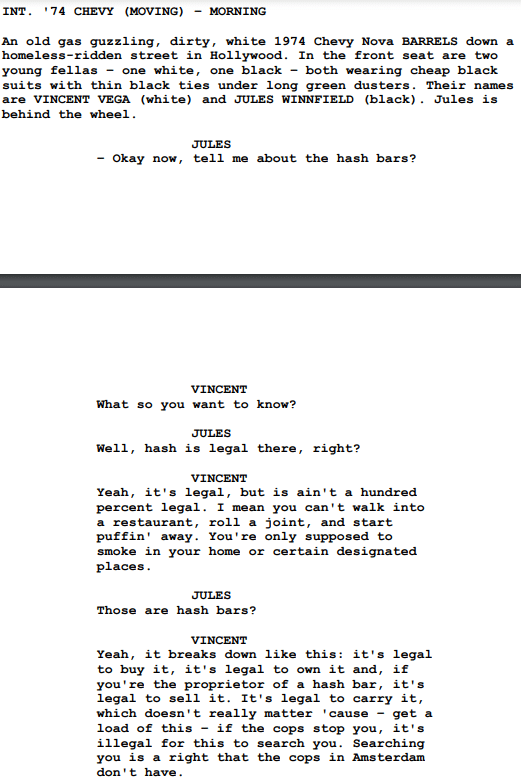
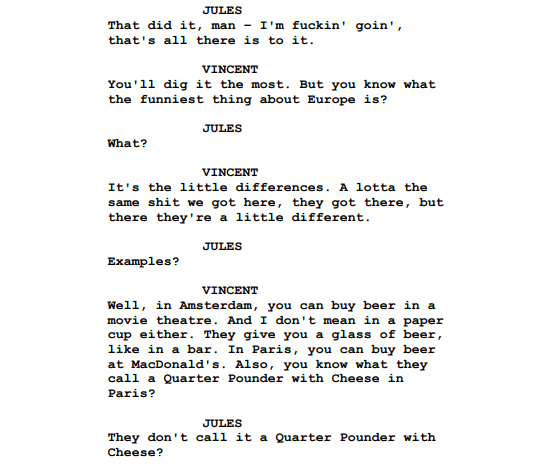
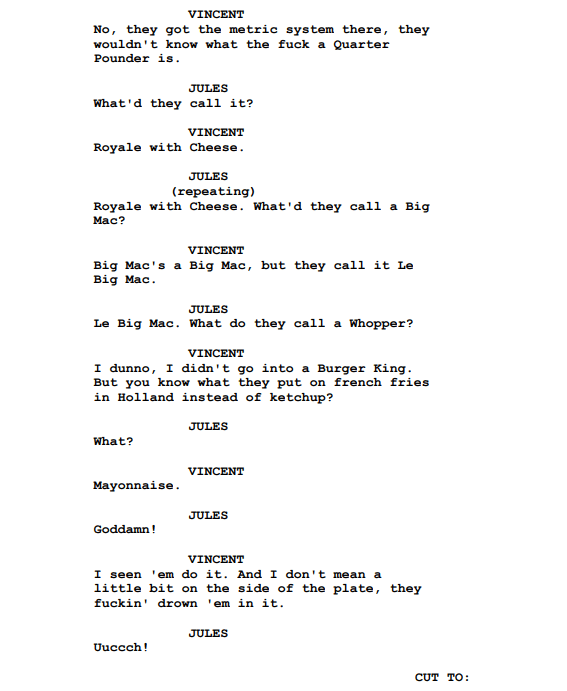
The dialogue between Jules and Vincent blends both humor and exposition, making it engaging rather than heavy-handed. The casual nature of their conversation also juxtaposes the tension of their hitman lifestyle – we know there’s more to them than meets the eye!
When Harry Met Sally (1989)
The witty, overlapping exchanges between Harry and Sally mirror the rhythms of real conversations, capturing both their personalities and evolving relationships.
A standout moment in the movie is the “can men and women be friends?” debate. The dialogue reveals their contrasting personalities (Harry’s cynicism versus Sally’s idealism) while advancing their dynamic relationship.
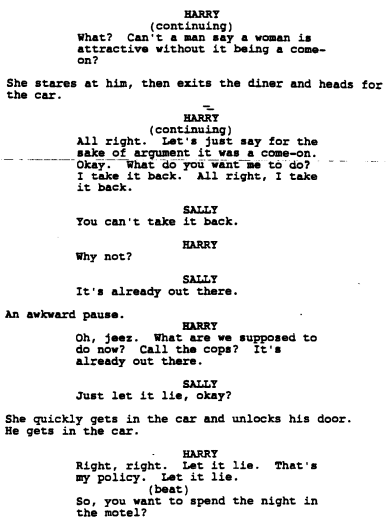
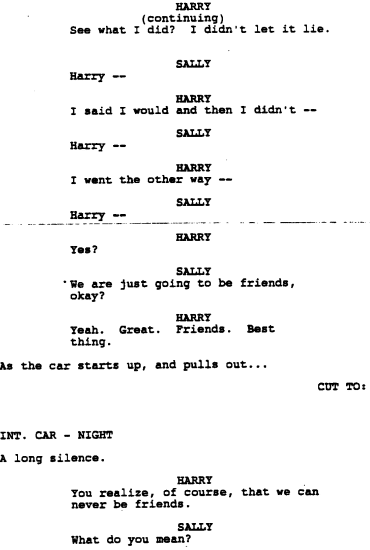
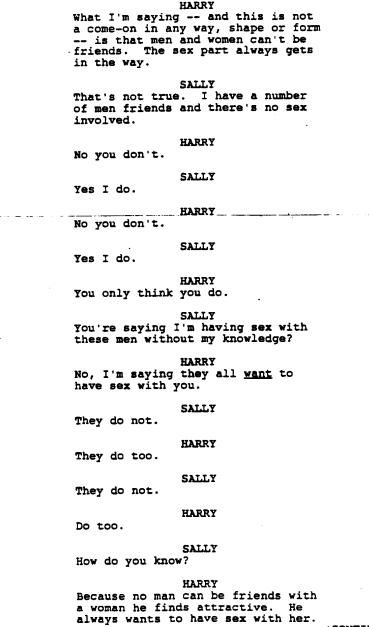
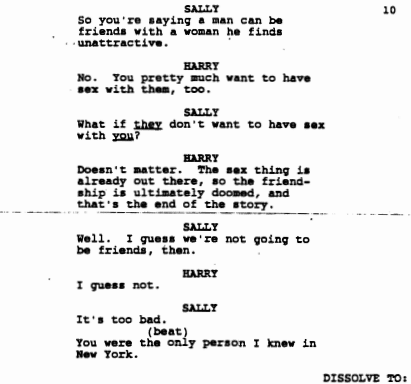
As we can see from the clip, and script, their discussion reflects natural speech patterns, including interruptions and tangents. Plus, it’s infused with both humor and charm, making the characters relatable and endearing.
Breaking Bad (2008-2013)
Walter White’s transformation is reflected in his dialogue. Early in the series, he hesitates and uses polite, almost deferential language.
But by the end of the series, his words become commanding and sharp. Let’s look at dialogue from episode one, as opposed to the last series.
In this first clip, we see Walter receive his devastating diagnosis.
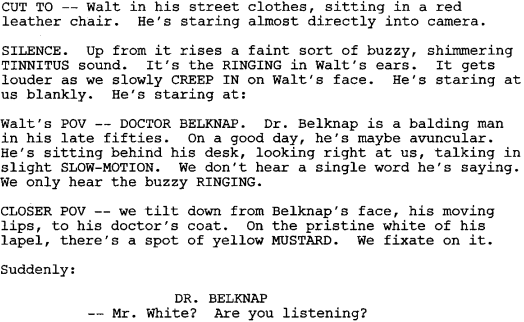
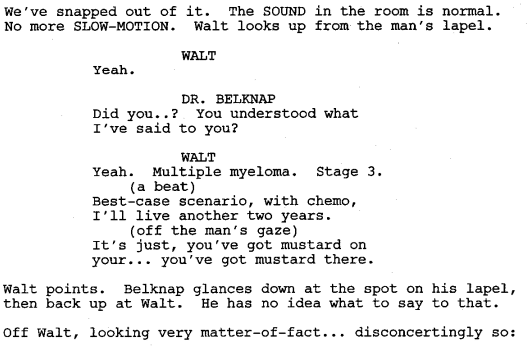
A pivotal moment in the pilot episode, yet he has little to say in his shock. Then, as we look at a scene further along in season four, we see a vastly different Walter White, as he fully embraces his drug lord status.
While we don’t have access to a script for this episode, here is the clip, demonstrating the shift in Walter’s character arc, underscoring his descent into criminality.
What’s most interesting about Gilligan’s writing is his belief that dialogue is sometimes overrated. He prefers to be known for writing great stories, rather than great dialogue.
Something for us to bear in mind also; while dialogue is important, it’s the story that will draw in and maintain our audience’s interest.
The Social Network (2010)
“What your character does reveals who they are. What they say reveals who they see themselves as.”
aaron sorkin
Aaron Sorkin’s script is renowned for its razor-sharp dialogue and there’s so much for us to learn from it as screenwriters.
The opening scene, where Mark Zuckerberg and Erica Albright argue in a bar, establishes Mark’s brilliance and arrogance while foreshadowing his downfall.
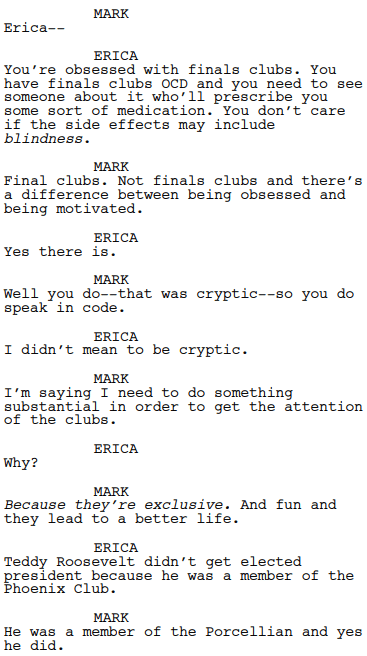
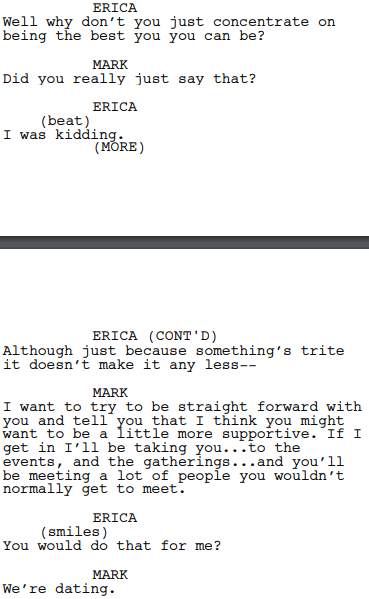
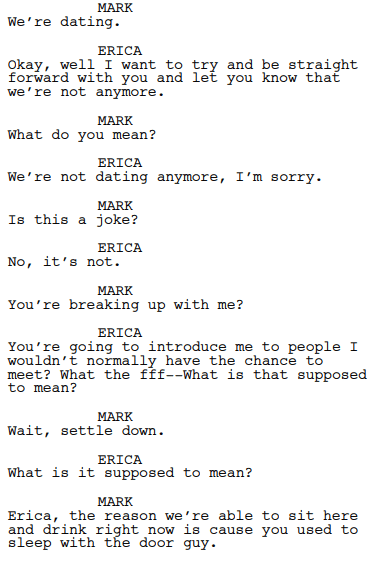
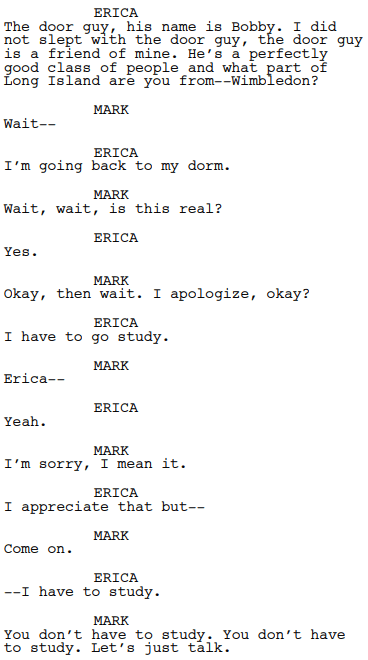
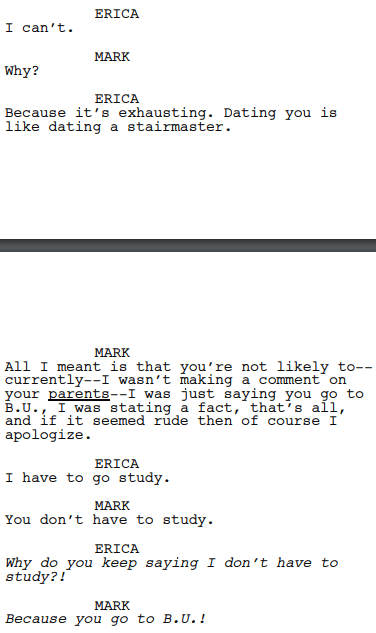

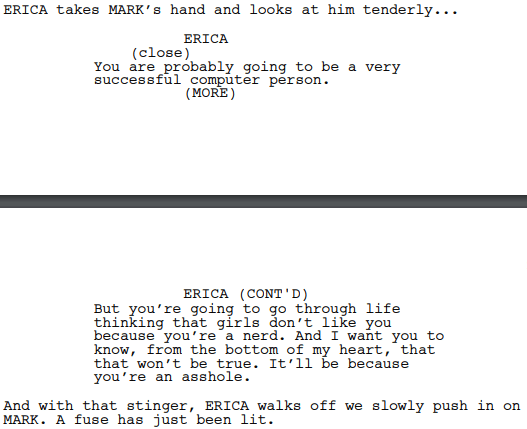
The quick-fire delivery of the dialogue creates an engaging rhythm that holds the audience’s attention. It also conveys a great deal of subtext, as Mark’s insecurities and ambition seep through his words.
Frequently Asked Questions (FAQ)
This is when characters state their subtext aloud. Example: “I am very sad that you lied to me.” Real people hide their pain through humor or silence.
Absolutely. Film is a visual medium. If the story can be told through a look or an action, it is often more powerful than a speech.
No. Overusing parentheticals (like angrily) is a sign of an amateur writer trying to micromanage the performance. Only use them if the line would be misunderstood without them.
Don’t write phonetically. Instead, capture the specific syntax and word order of the culture. Use one or two slang words to “seed” the voice.
Conclusion
Dialogue is a surgical tool, not a dumping ground for information.
By diagnosing the “fake” elements in your early drafts, you can begin to carve out characters that sound like living, breathing people. Remember that your dialogue is the “blueprint” for a performance.
Give your actors something to hide, something to fight for, and something to say.
Focus on your story, not your formatting.
Let Celtx’s Script Editor automatically apply all industry rules while you focus on the story.
Up Next:
5 Ways to Get Script Feedback That Actually Improves Your Story
You’ve polished your dialogue — now see if it lands. Learn how to source professional script feedback and use objective notes to identify the “undeniable pages” in your latest draft.