Have you heard?
We are currently witnessing a genuine spec script renaissance. In late 2025, major studio deals reached an eight-year high. In this fast-moving market, your screenplay doesn’t get 120 pages to make a first impression. It gets one sentence.
A strong logline is your project’s heartbeat — a sharp, concise pitch that determines whether a producer clicks Open or Delete. This guide provides the 2026 implementation blueprint to help you craft an undeniable hook in seconds.

What is a Logline and Why is it the DNA of Your Script?
A logline is a one- or two-line summary of your story that encapsulates your story’s core elements, such as the protagonist, the goal, the conflict, and the stakes.
However, be aware this isn’t the same as a tagline or a synopsis. Think of taglines as a catchy phrase that goes on the poster and is used exclusively for marketing.
For example, the famous tagline from the movie Alien, “In space no one can hear you scream”.
A synopsis however goes deeper into the story and allows you to showcase the strength of your writing. A logline is more geared towards showing the strength of the idea itself.
So, if you were pitching Alien to a producer, you would start with the logline which is: “A space crew aboard a cargo ship investigates a distress signal, allowing a deadly alien lifeform to stow aboard their ship, intent on killing them off one by one.”
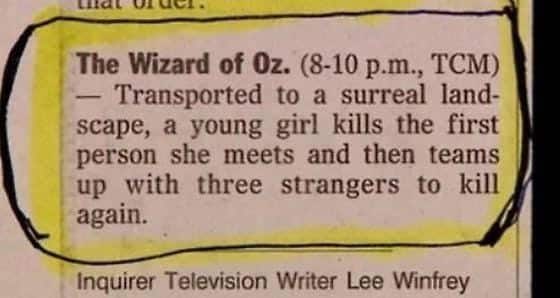
The Anatomy of a Master Logline: A Step-by-Step Breakdown
Writing a professional-grade logline is less like writing poetry and more like solving an equation. If you are struggling to summarize your script, it’s usually because you are missing a variable. To ensure your pitch is structurally sound, we recommend testing your story against these two professional formulas.
Formula A: The “Big But” (P + W, B – O = L)
This is the leanest way to check if you have a movie or just a situation. I call it ‘looking for the Big But.’
- Protagonist (P): A specific adjective + noun (e.g., “A disgraced detective”).
- Want (W): Their external, tangible goal.
- But (B): The turning point.
- Obstacle (O): The specific force making that goal impossible.
Example: A disgraced detective (P) wants to solve his final case (W), BUT (B) he discovers the culprit is his own partner (O).
Formula B: The Logistical Blueprint.
If your story is “high concept” or relies on a specific world, use this expanded formula to provide more context for the production team:
Setting + Protagonist + Problem + Antagonist + Conflict/Action + Goal
To illustrate, let’s dissect the logline from ‘Star Wars: A New Hope’:
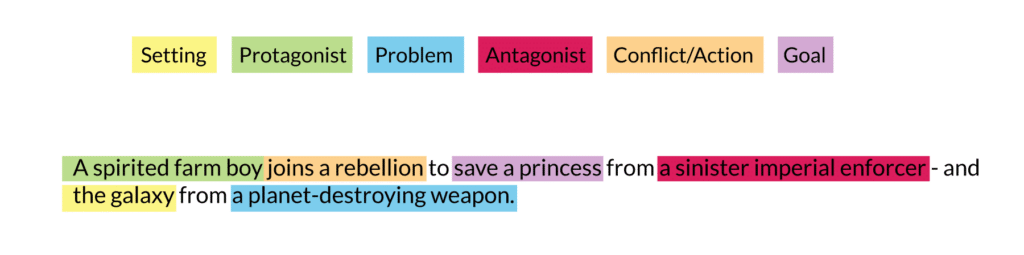
- Setting – The Galaxy: A setting establishes the tone and genre. A story spanning galaxies clearly leans towards science fiction, carrying certain expectations. Ensure your setting is clear and helps build your narrative.
- Protagonist – A Spirited Farm Boy: While Luke Skywalker is more complex, a brief, potent description suffices for a logline. Use impactful adjectives for conveying a lot within limited space. Names are unnecessary unless your character is already famous.
- Problem – A Planet-Destroying Weapon: A problem introduces stakes. The Death Star, capable of annihilating planets, underlines the dire consequences if the hero fails. Your problem should be significant enough to compel your hero into action.
- Antagonist – A Sinister Imperial Enforcer: Often, a single figure or entity is the source of the hero’s problem. They present a formidable challenge, embodying everything the hero isn’t.
- Goal – Save a Princess (And The Galaxy!): Your protagonist needs a clear goal. Although Luke’s goal evolves, his initial objective shapes the broader narrative arc.
- Conflict/Action – Joins a Rebellion: Conflict arises when the protagonist’s goal is thwarted by the problem and antagonist. In response to this challenge, Luke joins the rebellion, demonstrating that the hero’s decisions must drive the plot.
Putting These Formulas Into Action:
Condense these components into a succinct one or two-line pitch encapsulating your story’s essence, generally following the formula: protagonist + inciting incident + protagonist’s goal + central conflict.
Then, refine your logline, trimming down any non-essential elements until you’re left with an engaging elevator pitch. Don’t hesitate to test your logline on friends or family, as their reaction can indicate its effectiveness.
There are specific techniques to ensure your logline is memorable and engaging. Using active voice and vivid language helps paint a clear picture of your story. Highlighting the stakes and conflict generates intrigue, while maintaining simplicity and brevity makes your logline easier to remember and share.
Are you a more visual learner? Here’s our Fundamentals series video on How to Write a Logline:
5 Common Logline Mistakes Professional Readers Hate
A flawed logline is the fastest way to get an immediate rejection from an agent or producer.
Most amateur loglines fail because they are too vague, too passive, or focus on the feeling of the movie rather than the actual conflict. To win a reader’s attention in 2026, you must eliminate filler words and ensure your “Big But” (the central obstacle) is impossible to ignore.
1. The “Generic Character” Trap
Calling your protagonist “a man” or “a woman” tells a reader nothing about the story’s irony. Similarly, using character names like “John Smith” is a wasted word count because the reader has no emotional connection to that name yet.
- The Fix: Use a high-impact combination of a distinguishing adjective and a vocational noun. Instead of “John,” use “a disgraced detective” or “a terminally ill high school teacher.” This immediately establishes the character’s status and suggests their internal flaw.
2. Missing the “Big But” (The Conflict Gap)
The most common mistake I see is a logline that describes a situation but forgets the story. A logline like “A survivor tries to find a cure during a zombie outbreak” is just a premise. It’s missing the specific resistance that makes the journey difficult.
- The Fix: Always “look for the Big But.” Your logline must explicitly state the major obstacle standing in the character’s way. “A Gerry (P) wants to find a cure (W), BUT (B) he is trapped in a city with millions of infected (O).”
3. Using Passive “Thought Verbs”
Amateur writers often use verbs like “realizes,” “learns,” “comes to terms with,” or “wonders.” These are internal actions that cannot be filmed. Loglines that rely on these “thought verbs” feel slight and lack the narrative muscle to sustain a two-hour film.
- The Fix: Use active, visual verbs that describe physical struggle. Replace “realizes” with “struggles,” “journeys,” “fights,” or “escapes.” This tells the reader that your character is proactive and that your script is full of “shootable” action.
4. The “Theme Trap”
Don’t use your logline to explain what your movie means. Describing a film as “a profound meditation on the human condition and the nature of grief” adds zero information about what the audience will actually see on screen. It often comes across as pretentious to professional readers.
- The Fix: Focus entirely on the plot engine. A logline is a marketing tool, not an artist’s statement. Describe the “what” and the “how,” and let the reader infer the “why” from the irony of your setup.
5. The “Stakes Vacuum”
If your logline doesn’t answer the question “So what?”, it has failed. Many writers set up a character and a goal but forget to include the price of failure. If the audience doesn’t know what is at risk, they have no reason to be curious about the outcome.
- The Fix: Raise the stakes to “Galactic Proportions” — even in a small indie drama. Ensure the reader understands exactly what the character stands to lose (life, love, reputation, or home) if they don’t overcome the obstacle by the end of the script.
Conclusion
Crafting a compelling logline is a crucial skill for any writer looking to pitch their story successfully.
By understanding the basics of logline writing, analyzing successful loglines, following the steps to writing an effective logline, and using tips and techniques for writing a memorable logline, you can increase your chances of getting your work noticed and ultimately achieving success as a writer.
Remember that a logline is an elevator pitch for your story, and a good one can make your project, while a bad one can break it. So take the time to craft a strong logline that effectively conveys the essence of your story and highlights what makes it unique and compelling.
It may change and evolve over the course of a project so remember to keep rewriting it as your project develops.
Frequently Asked Questions (FAQ) About Loglines
A logline should be short and sweet, typically consisting of one or two sentences and a usually around 25-30 words.
Absolutely! Loglines can be changed after they’re written. It’s common for loglines to transform and shift as the story develops and takes shape. As the plot, characters, and themes become more defined, the logline may need to be tweaked to better capture the current state of the story or to emphasize new aspects that have emerged.
Here are a few things to ask yourself about your logline:
– Does it clearly and concisely convey the premise of your story?
– Does it grab the reader or listeners attention?
– Does it highlight what makes the story different or compelling?
– Is it easy to pitch to someone in a few seconds?
While specificity is important, a logline should still be concise. Avoid too much detail that might confuse or overwhelm. Focus on the key elements of the story and leave the rest to the imagination.
No. Unless your character is a real-life historical figure (like JFK), names mean nothing to a reader. Focus instead on a descriptive title that hints at their flaw or status (e.g., “An elitist funeral director”).
A logline is a sales tool that describes the story. A tagline is a marketing tool (like on a poster) that describes the feeling.
For example: “A young man reunites his parents” (Logline) vs. “He was 30 years early for dinner” (Tagline).
Focus on your story, not your formatting.
Let Celtx’s Script Editor automatically apply all industry rules while you focus on the story.