Every writer reaches that crossroads eventually. The one where you’re staring down two very different roads, both inviting, both intimidating, both whispering: Pick me. One road leads to a short film: concise, contained, and deceptively simple. The other stretches out into a full feature: sprawling, ambitious, and proudly demanding of your time, energy, and probably your wallet.
If you’re anything like most creatives, the debate becomes an internal tennis match. Do I go small and nimble? Or big and bold? Do I write the calling card? Or the career-maker? And then the particularly spicy question: Is choosing one secretly a sign I’m avoiding the other?
Take a breath. You’re not alone. And don’t worry, this crossroads isn’t actually a test but an opportunity to understand the story you’re trying to tell, the career you’re trying to build, and the resources you genuinely have right now.
And in today’s blog, we’re going to break everything down. So, let’s get on with it!
Table of Contents
- Short Film, Feature Film – What’s the Difference?
- Short Film vs. Feature Film: It’s About Scope, Not Just Length
- The “Whiplash” Strategy: Using a Short as a Feature Proof of Concept
- Structural Differences Between a Short Film and a Feature Film: The “Single Moment” vs. The “Triple Act.”
- Career Impact: When a Short Film is a Better Strategic Move Than a Feature
- Budgetary Realities: Cost-Per-Page for Independent Creators
- Checklist: 5 Questions to Determine Your Script’s Ideal Format
- FAQ
- Conclusion

Short Film, Feature Film – What’s the Difference?
Before we imagine this as a duel between formats, picture your current writing self as a general surveying a battlefield. On one side: the short film, lightweight but agile, perfect for a precision strike. On the other: the feature, a full-scale campaign requiring strategy, stamina, and proper supplies.
The “battle” is between intention and reality rather than the formats themselves. Between your creative impulse and your creative bandwidth, what the story wants to be and what your current circumstances will realistically allow.
Both short and feature films require skill. Both can elevate your career, and both can be colossal time-sucks if you approach the wrong format for the wrong story.
So how do you know which is right? Let’s start with scope.
Short Film vs. Feature Film: It’s About Scope, Not Just Length
Writers often fixate on page count as the defining difference between shorts and features. Ten pages vs. ninety. Budget for three days vs. budget for three months. A cast of two vs. a cast of twenty.
But length is only the surface difference. The real distinction is scope: the size, depth, and complexity of the emotional and narrative journey you’re crafting.
Short films thrive on focus. They’re at their strongest when they capture a single turning point, a single dilemma, a single irreversible decision. They compress the weight of a moment and let it detonate.
A short film doesn’t tell the whole story of a person’s life changing. It shows the moment their life can no longer stay the same.
Features thrive on expansion. They require multiple turns, layers, revelations, setbacks, and emotional recalibrations. You’re not spotlighting a moment anymore; you’re chronicling the ripple effect of many moments layered on top of each other.
If your story refuses to be contained to one moment. If it keeps insisting on subplots and supporting arcs and past wounds that need unpicking, forcing it into a short will only frustrate you.
Likewise, if your idea is built around one powerful emotional beat, stretching it to feature length will dilute what makes it special.
The “Whiplash” Strategy: Using a Short as a Feature Proof of Concept
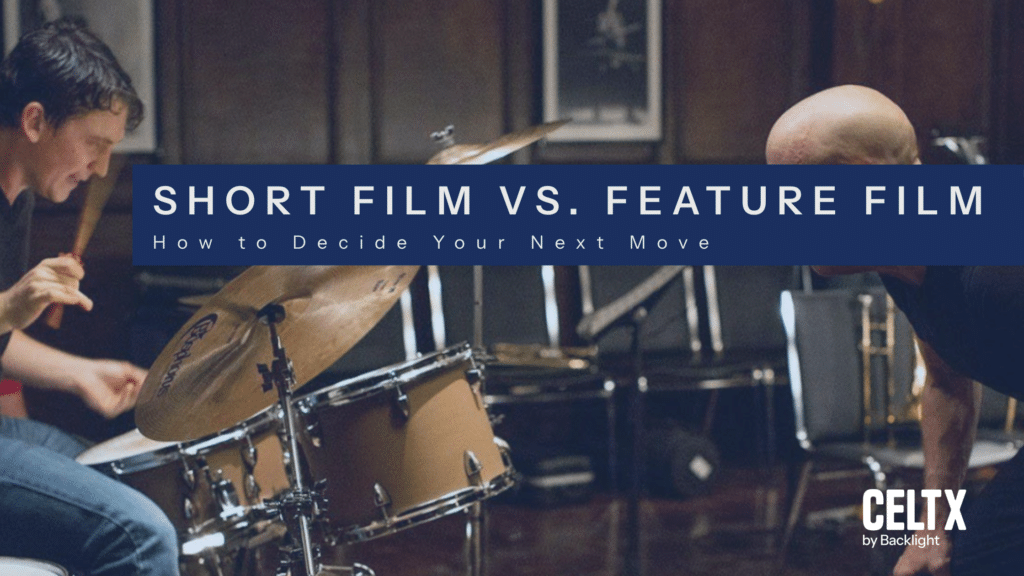
Few films have done more for the “short-to-feature pipeline” than Whiplash. Damien Chazelle wrote the feature, couldn’t get the money, turned one scene into a short, premiered it at Sundance, and the rest is Oscars-and-trauma-in-a-drummer’s-chair history.
The brilliance of this strategy is that it treats a short film as a strategic weapon: a cinematic pitch deck. It lets producers and investors feel the tone, style, performances, tension, and world. These are things that often don’t fully translate on paper.
But here’s the trick: not every feature idea should be prefaced by a short. The “short as proof-of-concept” works when:
- Your feature has a clearly isolatable moment that showcases the whole film’s DNA.
- The short can stand alone emotionally.
- The world or tone is heightened enough that visual demonstration provides a huge advantage.
- The short feels like a compelling artefact, not a trailer with the edges taped up.

On the flip side, this strategy doesn’t work well when:
- Your feature relies on slow-burn character evolution.
- The magic lies in cumulative emotional payoff.
- The genre isn’t immediately demonstrable (e.g., subtle relationship dramas).
- The short would feel hollow without the full arc.
Turning your feature into a short isn’t automatically smart; it needs to make creative and strategic sense. Whiplash worked because the key scene was the movie and showcased the film’s true essence.
Structural Differences Between a Short Film and a Feature Film: The “Single Moment” vs. The “Triple Act.”
One of the best ways to decide whether you’re writing a short or a feature is to look at your story’s structural needs.
Shorts are built around one of the following:
- One event
- One decision
- One turning point
- One emotional pivot
- One thematic punch
Their power lies in intensity and concentration. Think of them as pressure cookers. They’re small, contained, but capable of blowing the lid off when the tension soars.
Features, by contrast, need:
- A setup that defines the protagonist’s world.
- A disruption that forces transformation.
- A long middle section full of obstacles, reversals, and escalations.
- A climax that resolves not just the plot but the character arc too.
While shorts ask, “What’s the moment everything changed?”, features ask, “How did this change unfold?”
If your idea relies on a metamorphosis such as a worldview shifting, a relationship evolving, a secret unraveling, you’re in feature territory.
Whereas if your idea is a punch to the chest like one sharp, unforgettable emotional blow, then that’s a short through and through.
Career Impact: When a Short Film is a Better Strategic Move Than a Feature
Here’s a little industry secret: writing a feature doesn’t automatically move your career forward. Writing a short doesn’t automatically lead to small opportunities. Momentum is what moves you forward, and shorts can generate momentum faster than almost anything else.
A short film is strategically beneficial when:
- You need a calling card.
- A short shows what your writing feels like, not just how it reads.
- You want something made this year, not four years from now.
- Features take time. Shorts create immediacy.
- You’re trying to build relationships with directors, producers, cinematographers, or actors.
You’ll learn quickly that people are more willing to jump onto a 10-day project than a 3‑year one.
Plus, shorts have a far friendlier path into top festivals like Sundance. Features compete with studios, celebrities, and million-pound budgets. Shorts are judged with a much more level playing field as you’re still developing your creative voice.
A short is a low-risk laboratory where you can experiment with tone, genre, structure, and dialogue without committing to a marathon. And sometimes, a sprint is exactly what you need.

Budgetary Realities: Cost-Per-Page for Independent Creators
Let’s be brutally honest for a moment: unless you’re writing purely for practice, the budget matters. And for independent filmmakers, the budget matters a lot.
A feature script might cost nothing to write, but producing it is another story. Even the most micro-budget features often run $25,000–$150,000+ once you account for crew, cast, locations, kit, food, insurance, and post-production. And that’s assuming everyone is giving you generous “indie rates.”
Meanwhile, shorts can scale down infinitely. Two actors. One location. Two shoot days. A small, passionate crew. A handful of favours.
If you want to make the film yourself, a short is usually the pragmatic move.
But even if you’re not producing it yourself, budget still affects the writing. Producers are more likely to read and champion a short script they could viably make. A feature requires a much bigger commitment in terms of money, time, connections, and risk.
For a deeper dive, check out our 2026 indie film budget guide.
Checklist: 5 Questions to Determine Your Script’s Ideal Format
If you’re still hovering between formats, this checklist is designed to ground you. Think of it less as a rigid questionnaire and more as a quiet conversation with your story. Each question helps reveal what your idea actually needs, not what you feel you “should” be writing.
1. Is my story built around one turning point or many?
This is the foundational question. If your idea centres on a single moment that changes everything, you’re in short film territory. If you discover that your idea keeps branching into multiple beats, escalations, or revelations, it’s subtly signalling that it needs a longer runway.
2. Do I want to capture a moment or a journey?
Shorts excel when they preserve the emotional purity of one specific moment. They’re like a photograph that says more than an entire album. If what grabs you most about your idea is the intensity of a scene, an interaction, or a decision, then stretching it over 90 minutes will smother its power. But if your story feels like an odyssey, you’re in feature territory.
3. Does the idea demand subplots, supporting arcs, or layered themes?
Shorts can only hint at deeper themes; there is simply not enough real estate. If your idea relies on parallel storylines, contrasting character journeys, or multiple thematic threads, a short will feel like trying to pack a week’s holiday into a carry-on bag. #
A feature allows ideas to echo off each other. It gives your narrative room to breathe, expand, and complicate in ways shorts can only gesture toward.
Start your next script in Celtx. Try it for free today!
4. What resources do I actually have right now?
This is the question writers often avoid because it feels too practical but it’s vital. A feature requires stamina, time, emotional bandwidth, and often some level of financial or collaborative investment.
Writing a feature when you’re burnt out or time-poor can turn the process into a slog that saps your enthusiasm for the idea.
A short, on the other hand, can be completed in a matter of weeks and can be filmed without bankrupting yourself or your friendships. Be honest about where you are creatively and logistically. The right format should support you, not drain you.
5. Which format will move my career forward this year?
A feature might position you for agents, competitions, or long-term opportunities, but only if you have the time to finish it and polish it properly. A short might not land you a three-picture deal, but it can get you produced credits, festival screenings, collaborations, and momentum.
Think about your immediate goals: Do you want to be on set soon? Do you want to build a team? Do you want a sample that shows your tone, your voice, or your ability to craft performance-heavy scenes? Choose the format that gives you a step you can actually take.

FAQ
Absolutely. Many writers begin with a short as a creative experiment, then discover the emotional terrain is bigger than expected. If the idea deepens naturally rather than being forced to stretch, expansion makes sense.
In many ways, yes. Shorts teach you economy, clarity, and precision, all skills that will save your life when you later write a 100-page script. But the structures and rhythms are different, so writing both is valuable.
Often, yes, but only if the script is polished, distinctive, and marketable. A weak feature doesn’t open doors, but a strong one absolutely can. A brilliant short script can also spark interest, especially if it wins or places well at festivals.
They won’t make money the way features can, but they can pay dividends in access, collaboration, credibility, festival recognition, and future opportunities. Shorts are investments in relationships, not revenue.
It’s usually wise. Shorts let you learn the craft without overwhelming yourself, and they provide a finished piece you can share. But if your idea is clearly a feature, don’t shy away from it. Just commit to the long haul.
Conclusion
Choosing between a short film and a feature isn’t about bravery, legitimacy, or proving yourself. It’s about listening to your idea, your resources, your goals, and your current creative season.
Think of a short as a scalpel and a feature as a battlefield. Both are powerful, valid, and can change your career.
What matters is recognising what your story genuinely needs and what you’re genuinely ready to give it. When those two things align, format becomes obvious. The fog lifts and the choice feel less like a dilemma and more like clarity.
So, take your idea, hold it up to the light, and ask, “Is this a moment? Or a journey?” Your next move is hiding in the answer.
Simplify your script writing process.
Celtx’s screenwriting software is perfect for every project.
Up Next:

Feature, Documentary, or Short: Which Script Type Fits Your Story?
Now that you’ve chosen your format, it’s time to define your roadmap. Whether you are leaning into a 15-page short or a 120-page feature, understanding industry-standard script types is the only way to reach the right producers and festivals.