Editing is where screenplays are made or break completely.
You can feel it when a script hasn’t been edited properly. While the idea may be strong with compelling characters, something feels off. Scenes run long, stakes blur, and the dialogue explains too much and means too little. The draft isn’t bad; it’s just not finished.
Script editing isn’t about stripping the life out of your work or turning it into something cynical and “marketable.” Done well, it does the opposite. Editing reveals what your script is really about and helps the strongest version of it emerge.
In today’s blog, we’ll walk you through script editing step by step from knowing when to start, to tackling structure, character, dialogue, and polish in the right order so you can make confident, purposeful changes instead of endless, panicked tweaks.
Table of Contents
- What Is Script Editing (and Why It Matters)
- When Should You Start Editing Your Script?
- How to Edit a Script Step-by-Step
- 9 Script Editing Tips to Strengthen Your Draft
- Script Editing Examples (Before and After)
- Common Script Editing Mistakes to Avoid
- Script Editing Checklist (Free Download)
- Frequently Asked Questions (FAQ) About Script Editing
- Conclusion
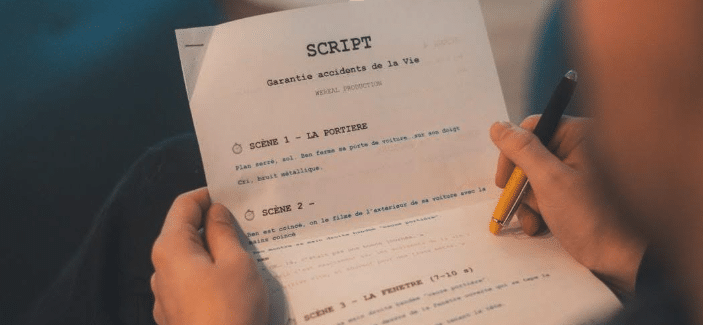
What is Script Editing (and Why it Matters)
Script editing is the process of evaluating, shaping, and strengthening an existing draft. It’s not the same as rewriting, and it definitely isn’t proofreading.
Editing focuses on questions like:
- Does the story work?
- Are the characters driving the plot?
- Is each scene pulling its weight?
- Are we building tension, momentum, and meaning?
Rewriting, by contrast, is where you generate new material, from new scenes to new plotlines and new approaches. Editing tells you what needs to change; rewriting is how you execute those changes.
This distinction matters because most scripts don’t fail due to bad ideas. They fail because the ideas haven’t been refined. Editing is where clarity appears. It’s where themes sharpen, character arcs become visible, and pacing stops fighting the story.
Put bluntly: if you skip proper editing, your script will always feel like a draft no matter how many times you’ve “rewritten” it.
When Should You Start Editing Your Script?
Not while you’re still drafting. The first rule of script editing is simple: finish the draft. Fully. End credits and all. Editing too early usually creates three problems:
- You fix things that would naturally resolve themselves later.
- You lose momentum and never finish.
- You start writing defensively instead of creatively.
Once the draft is complete, step away. A few days at minimum. A couple of weeks if you can manage it. Distance turns your script from something you remember writing into something you can actually read.
If you open the draft and feel slightly embarrassed: congratulations, you’re ready to edit!
How to Edit a Script Step-by-Step
Trying to “fix everything” at once is the fastest way to fix nothing. Effective script editing happens in clear, focused passes, each with a specific goal.
First Pass: Structure and Story
This is the least glamorous pass and the most important. Start big, don’t look at jokes or line edits, and look at what the story is doing and when.
Ask yourself:
- Does the story have a clear beginning, middle, and end?
- Does the protagonist want something specific?
- Are the stakes escalating, or repeating?
- Does the script move forward, or sideways?
Map out the acts. Identify turning points. Notice where momentum drops. If the second act feels baggy or the ending feels rushed, don’t paper over it with dialogue tweaks. Structural problems need structural solutions.
If a scene doesn’t change the situation in some way, it’s probably expendable.
Second Pass: Characters and Arcs
Once the structure holds, turn your attention to the people inside it. Strong screenplays track change. Even subtle, internal change matters, but it must be consistent and intentional.
Look closely at:
- What each main character wants
- What’s stopping them
- How they respond to pressure
- Whether their choices cause the plot, or just react to it
Check for motivation leaks. If a character acts “because the story needs it,” the audience will feel it even if they can’t name it. Every key decision should feel inevitable in hindsight, even if surprising in the moment.
Supporting characters deserve attention too. If two characters serve the same function, consider merging them. If a character disappears for long stretches, ask why they exist at all.
Third Pass: Dialogue and Voice
Only now should you start polishing dialogue. Good dialogue is all about intention. People rarely say exactly what they mean, and your characters shouldn’t either. Read scenes aloud and listen for:
- Exposition disguised as conversation
- Characters explaining things they already know
- Lines that exist only to summarise emotion
Cut filler. Trim greetings, small talk, and repeated beats. Plus, let silences work harder. Most importantly, make sure each character has a distinct voice. If you remove the names and anyone could say the lines, you’ve got work to do.

Final Pass: Pacing and Polish
This pass is about flow. Make sure to check scene length, check transitions, and notice where reading feels slow or effortful. Tighten action lines and break up dense paragraphs. And most importantly, make the page inviting.
Then (and only then!) worry about formatting, typos, and consistency. Technical errors won’t sink a great script, but they will undermine confidence in your professionalism.
9 Script Editing Tips to Strengthen Your Draft
1. Edit with a question, not a highlighter
Instead of “fixing,” ask one clear question per pass: structure, character, or pacing, and edit only for that.
2. Cut one scene you like
Choose a scene you enjoy but don’t strictly need. Remove it and see what breaks. Often, nothing does.
3. Track cause and effect
Every major event should cause the next one. Coincidence is a spice, not a system.
4. Shorten entrances and exits
Start scenes later than feels comfortable. End them earlier than feels polite.
5. Let actions carry information
If a line can be replaced by a behaviour, try it.
6. Watch for emotional repetition
If a scene doesn’t add new pressure, it’s restating a beat you’ve already played.
7. Give every scene a value shift
Something should be better or worse by the end, not just “understood.”
8. Cut adjectives in action lines
Precision beats decoration.
9. Finish before fixing
If you keep editing the first act, you’ll never discover what the third act needs.Check out this pro revision system from Big Red Stripe:
Script Editing Examples (Before and After)
Seeing editing in action makes the process feel far less abstract. Below are expanded examples that show how small, targeted changes can significantly improve clarity, pacing, and impact — without rewriting the entire script from scratch.
Example 1: Tightening Dialogue Without Losing Meaning
Before:

This line is polite, realistic and dramatically inert. Sarah isn’t doing anything with it. Instead, she’s hedging.
Let’s change this:
After:

The subtext hasn’t changed. Sarah still disagrees, but the energy has switched. The revised line is clearer, shorter, and creates forward momentum. It forces the other character to respond rather than politely nod.
When editing dialogue, ask: What is this line trying to achieve? Then remove anything that doesn’t actively serve that purpose.
Example 2: Cutting a Redundant Scene That Repeats Information
Before:
Midway through the script, two characters meet in a café to discuss a plan they already agreed on five scenes earlier. The scene reiterates stakes, confirms motivation, and ends with them heading off to do the thing we know they’re going to do.
Nothing is technically “wrong”, but nothing is new either.
After:
The entire scene is cut. One useful line of dialogue is relocated to a later argument where the plan begins to unravel.
Now the story moves faster, the audience isn’t reminded of information they’ve already processed, and the reused line gains more emotional weight because it now appears at a moment of conflict.
If a scene doesn’t add new pressure, information, or complication, it’s likely repeating a beat you’ve already played. Repetition slows pacing far more than omission.
Example 3: Improving Pacing by Combining Moments
Before:
Scene 24: A character hesitates about making a phone call
Scene 26: They express doubt to a friend
Scene 29: They finally make the call
Each scene is short, but the emotional progression feels padded.
After:
All three beats are folded into one scene. The character attempts the call, speaks to the friend mid‑attempt, and makes the decision on the spot when pressured. The decision feels active rather than delayed. The character appears braver, and the story regains momentum.
Multiple short scenes don’t automatically create pace. Sometimes fewer scenes with sharper internal turns are far more dynamic.
Example 4: Clarifying a Character Arc Through Action
Before:
A character claims they’ve “changed” in a closing monologue, explaining what they’ve learned and how they’re different now.
After:
The monologue is removed. Instead, the character makes a small but concrete choice that directly contradicts how they behaved in Act One.
The transformation becomes visible rather than theoretical. The audience infers the change instead of being told about it.
Character arcs are proven through behaviour. If you can show change in action, you rarely need to explain it in words.

Common Script Editing Mistakes to Avoid
Even experienced writers fall into predictable traps when editing. These mistakes don’t come from laziness but from caring too much about the wrong thing at the wrong time.
Polishing Dialogue Before Fixing Structure
Writers love dialogue because it’s visible, satisfying work. Re‑shaping dialogue feels controllable in a way story doesn’t. But no line, however sharp, can fix a weak second act or an unclear protagonist goal.
So, if you keep tweaking conversations, but the script still feels “off.” A better approach for this would be to solve story problems first. Dialogue becomes easier and often shorter once the structure is solid.
Mistaking Editing for Rewriting
Endless rewriting can disguise uncertainty. If you’re generating new versions without identifying why something isn’t working, you’re guessing instead of editing. That’s how drafts multiply without improving.
Instead, name the problem before you change anything. Is the scene too slow? Is motivation unclear? Is the conflict missing? Editing starts with diagnosis.
Ignoring Feedback Entirely (or Taking It Too Literally)
Some writers reject all notes while others apply every single one. Both approaches miss the point.
Feedback doesn’t tell you how to fix your script, but where a reader got confused, bored, or disengaged. Those reactions matter even if the suggested solution doesn’t.
Instead, look for patterns. If multiple readers flag the same moment, there’s a real issue underneath, even if you choose a different fix.
Treating Formatting and Typos as “Real” Editing
Clean formatting matters, but it’s surface‑level work. It’s far easier than addressing story problems which is why many writers gravitate toward it.
A perfectly formatted script with weak character logic is still a weak script. So, leave technical polish for the final pass. Earn the right to polish by making the script work dramatically first.
Being Afraid to Cut Good Material
Strong scenes are sometimes wrong for this script. Cutting a well‑written moment can feel like self‑sabotage but clinging to it often damages pacing or focus.
Save deleted scenes in a separate document. Knowing they’re not “lost” makes sharper decision‑making possible.
Script Editing Checklist (Free Download)
Editing your script is easier when you have a clear system. Use Celtx’s Script Editing checklist to guide each pass and make sure nothing gets overlooked.
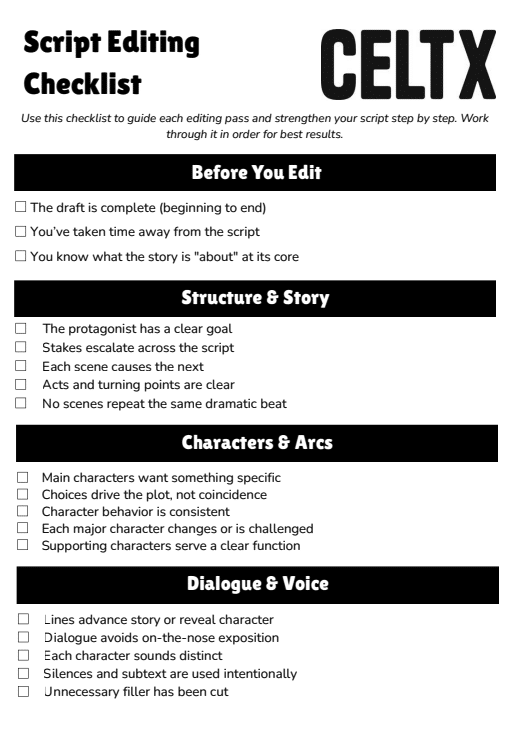

Click here to download the free Celtx Script Editing Checklist
Frequently Asked Questions (FAQ) About Script Editing
Script editing is the process of evaluating and refining an existing screenplay to strengthen its story, characters, structure, and pacing.
Longer than writing the draft, and that’s normal. Editing is iterative and benefits from multiple focused passes.
In my experience, you should walk away from your script for at least one to two weeks before starting the edit. This reset period allows you to view your work with a scientist’s objectivity, making it easier to identify flaws that you were too close to see during the initial writing process.
Editing identifies what needs improvement. Rewriting creates new material to address those issues.
AI can be a powerful co-editor for identifying grammatical errors or summarizing pacing issues, but it currently lacks the “Ears of a Filmmaker” needed to judge emotional resonance and subtext.
The best practice is a hybrid workflow: use tools to catch mechanical errors, but rely on human expertise to ensure your characters sound authentic.
It’s finished when further changes no longer make it clearer, sharper, or truer — only different.
Conclusion
Editing is the craft that turns effort into intention. Every strong script you admire went through this stage, probably several times, with moments of doubt, frustration, and ruthless clarity. Remember, you’ve got to let the process do its job.
If writing is discovering the story, editing is learning how to tell it cleanly, confidently, and without apology. And that’s where your script becomes ready to be read.
Start your next edit in Celtx.
Turn your draft into a production-ready screenplay
Up Next:
5 Ways to Get Script Feedback That Actually Improves Your Story
You’ve polished the prose—now see if it lands. Learn how to source professional script feedback and use objective notes to identify the “undeniable pages” in your latest draft.