Key Takeaways
- A Story Spine is a simple cause-and-effect framework that maps story movement from setup through climax to resolution
- Unlike beat sheets, story spines stay high-level and flexible, making them perfect for early-stage story testing
- The classic Pixar structure (Once upon a time → Every day → Until one day → Because of that → Until finally → Ever since then) works across all genres
Introduction
Every story needs a backbone. You can have a brilliant character, a strange world, a killer opening image, a funny concept, or a heartbreaking ending, but if the story itself doesn’t have a clear shape, the whole thing can start to wobble. That’s where the Story Spine comes in.
A Story Spine is a simple framework that helps writers map the basic movement of a story from beginning to end. It’s not as detailed as a beat sheet, and it’s not meant to solve every problem in your plot. Think of it more like the skeleton beneath the story. It gives you a clear sense of setup, disruption, escalation, climax, and resolution before you start adding all the flesh, feeling, jokes, betrayals, and emotional damage.
Whether you’re writing your first screenplay or untangling a messy draft, the Story Spine is one of the most useful tools in your writing toolkit. In today’s blog, we’ll explore how it can help provide a clear framework for your next script.

What Is a Story Spine?
A Story Spine is a short, structured outline that breaks a story into a sequence of cause-and-effect steps. It’s often associated with Pixar’s storytelling approach, though variations of the framework have been used by writers, teachers, improvisers, and storytellers for years.
The classic version uses a repeated sentence pattern:
- Once upon a time…
- Every day…
- Until one day…
- Because of that…
- Because of that…
- Because of that…
- Until finally…
- And ever since then…
It looks almost too simple at first, which is part of the charm. The Story Spine is not trying to make your story sound impressive but as clear as possible.
Each line has a job. “Once upon a time” introduces the world and character. “Every day” establishes the normal pattern of life. “Until one day” disrupts that pattern. The repeated “because of that” lines create escalation. “Until finally” brings the story to its decisive moment. “Ever since then” shows how the world or character has changed.
That structure is useful because stories are chains of consequence. This happens, so that happens. A character makes a choice, which creates a problem, which forces another choice, which leads to a bigger consequence.
The Story Spine helps us writers see that chain clearly.
Why Writers Use Story Spines
Writers use Story Spines because they’re quick, flexible, and very hard to hide behind.
A long outline can sometimes disguise a weak story. You can have pages of notes, detailed worldbuilding, character playlists, mood boards, and 400 years of family history, yet still not know what the main character actually does in Act Two.
A Story Spine cuts through that; it asks for the simplest version of the story, not the cleverest or the beautifully worded version.
That makes it especially useful in the early stages of writing. Before you commit to a full beat sheet or draft, you can test whether the story has movement. Does something change? Does the protagonist face pressure? Do their choices create consequences? Does the ending feel connected to the beginning?
It’s also useful when a draft already exists but feels messy. If the screenplay has too many subplots, a slow middle, or an unclear character journey, writing a Story Spine can reveal what the central story actually is. Sometimes the problem is not that the writer doesn’t have enough ideas. It’s that the strongest idea is buried under six slightly less important ones. Celtx’s beat sheet tool helps you separate the core story from the subplots that distract it.
Story Spine Template
Here is the basic template:
- Once upon a time – Introduce the protagonist and the world they live in.
- Every day – Show the character’s normal life, routine, problem, flaw, or emotional pattern.
- Until one day – Introduce the event that disrupts that normal life.
- Because of that – Show the first major consequence or choice.
- Because of that – Escalate the situation. The character is pulled deeper into the story.
- Because of that – Increase the pressure again. The problem becomes harder to avoid.
- Until finally – Bring the character to the decisive climax, choice, confrontation, or turning point.
- And ever since then – Show what has changed by the end.
You can add more “because of that” lines if the story needs them, especially for a feature film or TV pilot. Just be careful not to turn the Story Spine into a full scene-by-scene outline. The point is to capture the main chain of cause and effect.
For us screenwriters, it can help to keep every line focused on action. A film or TV episode can’t only be about things happening around the protagonist. At some point, the character needs to make choices that push the story forward. If your protagonist is passive or purely reactive in your story spine, that’s a signal to revise the story itself, not just add more action
Story Spine Example
Let’s use a simple original example.
Once upon a time, there was a talented but anxious wedding photographer named Maya, known for capturing everyone else’s happiest moments while avoiding her own life.
This gives us a protagonist, a world, and a little emotional contradiction. Maya photographs love, but she is not fully participating in her own life.
Every day, she hid behind her camera, working constantly and convincing herself that watching from the sidelines was safer than wanting too much.
Now we understand the pattern. This isn’t just her job but her emotional hiding place.
Until one day, she was hired to photograph the wedding of her ex-best friend, the woman she had not spoken to since a painful falling-out years earlier.
This disrupts her routine and forces the past into the present.
Because of that, Maya tried to treat the job like any other booking, but every speech, photograph, and familiar face brought back the friendship she had never properly grieved.
The external job creates internal pressure.
Because of that, she began making mistakes and slowly realised she was not angry about the wedding; she was angry that everyone else seemed to have moved on.
The situation escalates and reveals the real emotional issue.
Because of that, when she discovers the bride is also nervous and still hurt by their fallout, Maya has to decide whether to keep hiding behind professionalism or finally tell the truth.
Now the story is pushing towards a choice.
Until finally, during a quiet moment before the reception, Maya lowers the camera and apologises, not to fix everything instantly, but to stop pretending the friendship never mattered.
This is the emotional climax. While the action is small, the choice is a meaningful one.
And ever since then, Maya still takes photographs for a living, but she no longer uses the camera as an excuse to stay outside the frame of her own life.
That’s the value of a Story Spine. It doesn’t give us every scene, but the shape of a film. We know who Maya is, what pattern she is stuck in, what disrupts her, how the pressure escalates, what choice she has to make, and how the ending reflects the journey.
Story Spine vs Beat Sheet
A Story Spine and a beat sheet are related, but they’re not the same thing.
A Story Spine is the simple version of the story’s movement focusing on the central chain of cause and effect. It’s usually short, broad, and easy to revise.
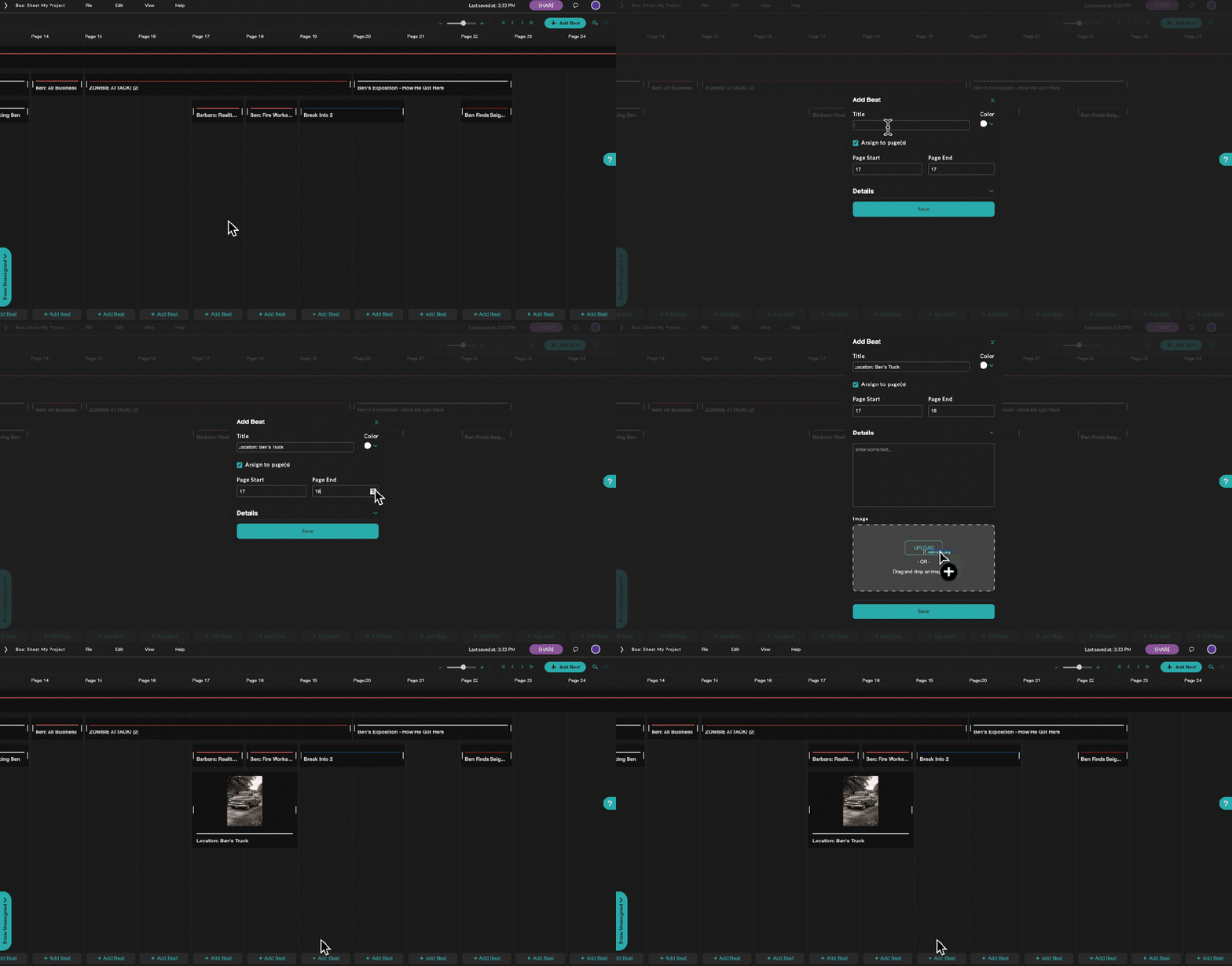
On the other hand, a beat sheet is more detailed. It breaks the story into major dramatic beats, often using act structure, turning points, sequences, midpoint shifts, low points, climaxes, and resolutions. A beat sheet starts to show how the story will actually unfold on the page.
Think of the Story Spine as the “what happens and why” stage. Think of the beat sheet as the “how it happens scene by scene” stage.
Turning a Story Spine into a Screenplay
Once you have a working Story Spine, the next step is to expand each line into dramatic material.
Start with the protagonist. The first two lines should help you understand who they’re before the story changes them. What do they want? What are they avoiding? What belief keeps them stuck? What does their ordinary world look like on screen?
Then look at the disruption. The “until one day” moment should be strong enough to force movement. It doesn’t always need to be explosive. It might be a death, a job offer, a diagnosis, a betrayal, a wedding invitation, a missing person, a strange discovery, or a humiliating mistake. The key is that the character can’tsimply return to normal afterwards.
The “because of that” lines are where many stories either come alive or fall apart. These lines should create a chain. One choice causes the next problem. One revelation forces a new decision. One attempt to fix things makes the situation more complicated.
If your “because of that” lines could be rearranged in any order, the story may not yet have enough cause and effect.
The “until finally” line should force the character into the most important choice of the story. This is where the external plot and internal arc should collide. The character must do something they couldn’t have done at the beginning or fail to do something because they have not changed enough.
Finally, use the “ever since then” line to clarify the ending. The ending can be happy, tragic, bittersweet, ironic, or unsettling. It simply needs to show that the story has left a mark.
FAQ
o. The language can sound fairy-tale-like, especially because it begins with “Once upon a time,” but the structure works for all kinds of stories. Dramas, thrillers, comedies, horror films, romances, animations, and TV pilots can all be tested through a Story Spine. The “Once upon a time” framing is simply a storytelling convention; the structure itself is universal across all genres and formats.
A Story Spine is usually short. One paragraph to one page is plenty. If it becomes several pages long, it may be turning into an outline or beat sheet. That can be useful later, but the initial Story Spine should stay focused on the central movement of the story.
Yes, though it’s often most useful for a pilot, episode, or season arc rather than every detail of the entire series. For a pilot, the Story Spine can clarify how the protagonist is pulled into the premise. For a season, it can map the larger change from opening status quo to finale.
You can create one Story Spine for each major character. This is especially useful for ensemble films or dual-protagonist stories. Once you have each spine, look at where the journeys overlap, clash, or change each other.
No. A logline is a short pitch, usually one or two sentences, designed to communicate the hook of the story. A Story Spine is a development tool. It gives you more room to explore the beginning, escalation, climax, and ending. A logline sells the story; a story spine builds it. You need both, but at different stages of development. See our guide on how to write a logline for pitch-ready one-liners.
Keep reading on the Celtx blog:
- Why Your Script Feels Boring (and How to Fix It Fast)
- What Happens After Your First Draft? The Real Script Revision Process
- How to Raise the Stakes: 5 Pro Techniques to Fix a “Flat” Script
Free Resource: Story Spine Template
Download our free Story Spine Template and start mapping your story’s setup, escalation, climax, and ending in minutes. The template includes prompts for each line, real-world examples, and space to test multiple story versions side by side.

Conclusion
The Story Spine is simple, but that’s exactly why it works.
It strips away the noise and asks whether your story has a clear shape. A character exists in a world. A pattern is disrupted. Choices create consequences. Pressure builds. A final moment forces change. By the end, something is different.
That may sound basic, but basic is not the same as easy. Many drafts struggle because the writer has lots of scenes, ideas, themes, and characters, but no clear chain holding them together. A Story Spine gives you that chain.
Before you get lost in act breaks, set-pieces, subplots, reversals, and dialogue polish, try writing the simplest version of your story. You may discover what it’s really about. You may also discover what has been missing all along.
Every strong story needs a backbone. The Story Spine helps you build one before the whole thing collapses under the weight of its own cleverness.
For stories of all structures, Celtx’s tools help you move from core concept to screenplay-ready outline in one unified workflow.
Focus on your story, not your formatting.
Let Celtx’s Script Editor automatically apply all industry rules while you focus on the story.