Music videos can look effortless when they work well. A few striking images, a great performance, some beautiful lighting, maybe a dramatic slow-motion walk down a street at night, and suddenly the song feels ten times bigger.
But behind most strong music videos is a plan. Not always a traditional screenplay, because music videos don’t usually work like dialogue-led films, but a clear visual roadmap that helps the director, artist, crew, and production team understand what they are making. That is where a music video script comes in.
Whether you’re writing a narrative video, a performance-based concept, an experimental visual piece, or a mix of all three, your script needs to translate the song into images. It needs rhythm, progression, and purpose. Most importantly, it needs to support the music rather than fight it.
And in today’s blog we’ll explain just how to get there.
Table of Contents
- Do You Need a Script for a Music Video?
- What Makes Music Video Scripts Different?
- What Is an AV Script Format?
- How to Turn a Song into Visual Beats
- Structuring a Music Video Concept
- Shot Planning for Music Videos
- Common Mistakes in Music Video Scripts
- Example: Music Video AV Script Breakdown
- FREE Music Video AV Script Template
- FAQ
- Conclusion

Do You Need a Script for a Music Video?
Writing a music video script is a strange and brilliant challenge because the song already gives you so much: tone, pace, mood, emotion, structure, and often a central idea. Your job is not to explain the song. Your job is to create a visual experience that feels like it belongs to it.
That might mean telling a story that reflects the lyrics. It might mean creating a completely separate visual metaphor. It might mean building a performance video around movement, costume, location, and atmosphere.
A good music video script gives everyone enough detail to understand the concept, without overloading the production with unnecessary description. Think of it as a bridge between the song and the shoot.
You might not need an actual script for your music video that looks like the one you’d write for a film, but you do need a plan.
What Makes Music Video Scripts Different?
A traditional screenplay is built around scenes, dialogue, character action, and plot. A music video script is usually built around music structure, visual beats, performance moments, and timing.
Instead of asking, “What does the character say next?” you’re focusing on:
- What happens during the intro?
- How does the first verse look?
- Does the chorus repeat the same visual idea or escalate it?
- Where does the artist perform?
- Do the visuals follow the lyrics, contrast them, or create a separate story?
- How does the video build toward its final image?
Music videos also tend to be more visual and less literal. You may not need dialogue at all. You may not even need a conventional plot. But you do need movement. Something should shift from beginning to end, even if that shift is emotional, symbolic, or purely visual.
A music video should feel designed and not like a random cluster of ‘nice-looking’ shots.
What Is an AV Script Format?
An AV script, or audio-visual script, is a format that separates what we hear from what we see. It’s often laid out in two columns: one for audio and one for visuals.
The audio column might include lyrics, music sections, sound effects, voiceover, or timing notes. The visual column describes the images, action, performance, camera ideas, locations, or transitions happening alongside the sound.
For a deeper breakdown of the format, check out our AV script blog.
For music videos, AV format is especially useful because it lets you map visual beats directly against the song. Instead of writing a normal screenplay and hoping the rhythm matches later, you can plan the video section by section.
A simple AV script layout might look like this:
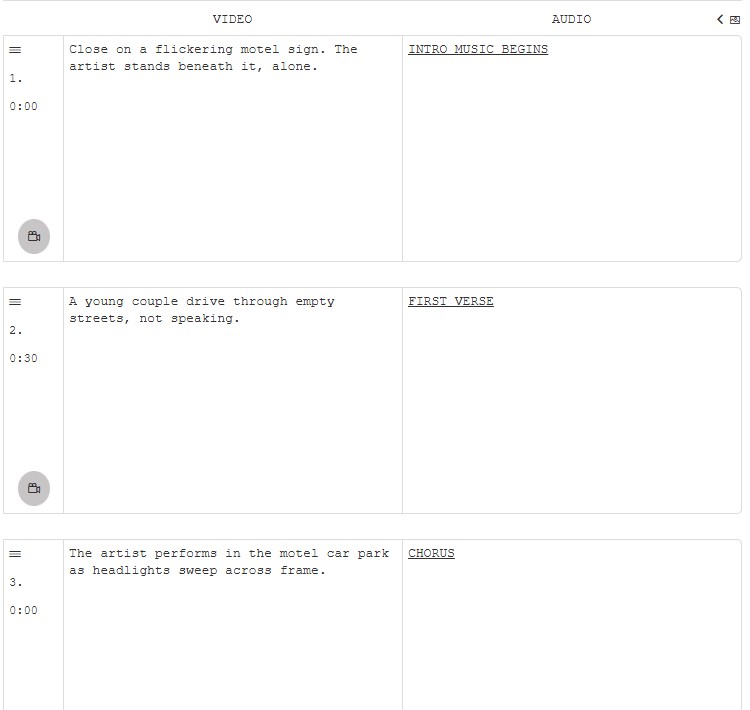
The format is practical, visual, and easy for collaborators to follow.
How to Turn a Song into Visual Beats
Start by listening to the song without writing anything. Then listen again and mark its structure: intro, verse, pre-chorus, chorus, bridge, final chorus, outro.
Next, write down the emotional movement. Does the song begin intimate and become explosive? Does it start angry and end vulnerable? Does it feel like escape, grief, celebration, obsession, nostalgia, confidence, or heartbreak?
Once you understand the emotional journey, you can begin turning sections into visual beats.
The intro might establish the world. The first verse might introduce a character or situation. The chorus might reveal the main visual hook. The second verse might complicate the story. The bridge might break the pattern. The final chorus might deliver the biggest image.
You don’t need to illustrate every lyric. In fact, being too literal can make a music video feel flat. If the lyric says, “I’m drowning,” you don’t automatically need a bathtub, rainstorm, or ocean. Maybe the character is surrounded by people at a party and can’t breathe emotionally. That may be more interesting.
Structuring a Music Video Concept
Most music videos use one of three broad structures: performance, narrative, or conceptual. Many use a combination.
A performance video focuses on the artist singing, playing, dancing, or moving through a designed visual space. The drama comes from styling, lighting, location, camera movement, choreography, and energy.
A narrative video tells a story. It may follow the lyrics closely, or it may use the song as emotional support for a separate plot.
A conceptual video is built around an image, metaphor, visual rule, or artistic idea. It might not have a traditional story, but it still needs progression.
A strong structure might look like this:
- Intro: set up the visual world.
- Verse 1: introduce the emotional situation.
- Chorus 1: reveal the main visual hook.
- Verse 2: escalate or complicate the idea.
- Chorus 2: intensify the performance or story.
- Bridge: shift tone, location, or perspective.
- Final chorus: deliver the biggest visual payoff.
- Outro: end with a memorable final image.
Even if the video is abstract, this shape helps it feel like it’s going somewhere.
Shot Planning for Music Videos
A music video script doesn’t need to list every shot like a full shot list, but it should suggest the visual language. Are we handheld and intimate? Smooth and glossy? Static and theatrical? Fast-cut and chaotic? Dreamy and slow?
Think about the key shot types you need:
- Performance shots: the artist singing to camera, performing with a band, dancing, or moving through a location.
- Narrative shots: characters making choices, reacting, leaving, chasing, hiding, remembering, or confronting.
- Detail shots: hands, objects, textures, lights, clothing, instruments, messages, photographs.
- Transition shots: match cuts, whip pans, light flares, doorways, reflections, or movement that carries us between sections.
- Hero shots: the most memorable images of the video, often saved for choruses or climactic moments.
The script should give production enough information to plan locations, props, costumes, lighting, and schedule. If the video needs a burning car, twelve dancers, a rooftop, and a horse, that needs to be clear early. Ideally before someone says, “We can shoot this in one afternoon,” and everyone cries.
Common Mistakes in Music Video Scripts
There’s already a lot to think about so bear these common mistakes in mind to make sure you don’t fall into any traps.
Being too Literal
If every lyric is acted out exactly, the video can feel obvious. Look for emotional or visual interpretations instead.
Having No Progression
A series of beautiful images isn’t always enough. The video should build, shift, or transform in some way.
Ignoring the Artist
Even in narrative videos, the artist’s presence matters. Decide whether they are a performer, character, narrator, observer, or symbolic figure.
Overcomplicating the Concept
A music video has limited time. If the idea needs ten minutes of explanation, it may be too complicated.
Forgetting Production Reality
Write with budget, locations, time, and resources in mind. A simple idea executed beautifully is usually stronger than an impossible idea half-produced.
Treating the Script like a Feature Film
Music video scripts are rhythm-led. They need visual beats, mood, and timing more than traditional scene dialogue.
Example: Music Video AV Script Breakdown
Here is a simple example for a fictional heartbreak song called “Last Light.”
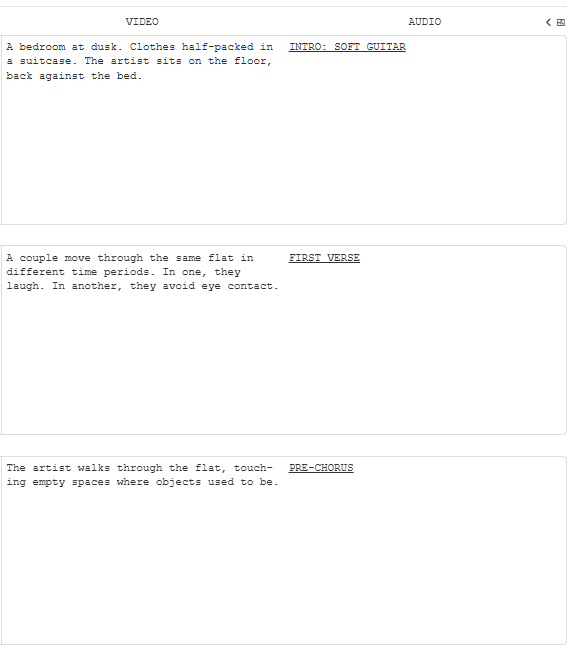


Notice how the video doesn’t explain every lyric. But it gives the song a visual emotional arc: memory, loss, release, and finally, movement forward.
FREE Music Video AV Script Template
To make things easier, here’s a simple AV script template you can use when planning your own music video. The format separates the audio from the visuals, helping you map each section of the song to what appears on screen.
Use the audio column for lyrics, timestamps, instrumental sections, sound effects, or key musical changes. Use the visual column to describe performance moments, narrative beats, locations, shot ideas, transitions, and important images.
This gives you a clear, practical overview of how the video will move from beginning to end before you start building shot lists, storyboards, or production schedules.
Download your free template here.
Alternatively, start your own Celtx account and create your AV script directly in your dashboard!
FAQ
Not always, but it does need a plan. A script or AV breakdown helps clarify the concept, timing, visuals, and production requirements before the shoot.
AV format is often the clearest choice because it places audio and visuals side by side. This makes it easier to match images to song sections.
Usually, no. It can, but the strongest music videos often interpret the emotion behind the lyrics rather than acting out every line.
Detailed enough for the team to understand the concept, locations, visual beats, and production needs. It shouldn’t be so detailed that it removes room for direction, choreography, and performance.
Yes, but use it carefully. Dialogue can work in intros, outros, or narrative breaks, but it shouldn’t distract from the song unless that is part of the concept.
Conclusion
A music video script is not just a written description of cool shots. It’s a plan for how the song becomes visual.
The best music video scripts understand rhythm, emotion, structure, and production. They know when to follow the lyrics and when to push beyond them. They give the artist a clear presence, the visuals a sense of progression, and the production team a practical roadmap.
Whether your idea is intimate, cinematic, strange, funny, romantic, or completely surreal, start with the song, listen to its movement, find its emotional center, and build visual beats that grow with it.
Stop formatting split columns manually—write your music video in Celtx.
Use our automated AV script editor to seamlessly sync your lyrics, beats, and on-screen visuals in real-time.
Up Next:

How to Write a Script for a YouTube Video
You’ve mastered the AV format for music—now apply it to video content. Learn how to write highly engaging YouTube scripts that hook online audiences and maximize watch time.