Corporate video production is rarely glamorous. It’s not red carpets or cinematic passion projects. Instead, it’s feedback loops, brand committees, shifting goalposts, tight deadlines, and clients who ask for “just a small tweak” six revisions in.
If you run a small agency, you already know the reality: inboxes full of contradictory feedback, approvals that never quite feel final, timelines that stretch without warning, and scope creep disguised as collaboration.
Most agencies assume this chaos is just part of the job. It isn’t. The real issue is a lack of a scalable workflow. Without structure, every project becomes a bespoke problem, and bespoke problems don’t scale. They exhaust teams, burn out freelancers, and trap agencies in survival mode instead of growth mode.
In today’s blog, we’ll guide you through building a repeatable, reliable corporate video production system that allows your agency to grow without multiplying stress, complexity, and operational friction.

The Core Stages of Corporate Video Production
Every successful corporate video follows the same structural logic, whether agencies admit it or not.
Pre-production is where success is decided, production is where execution happens, post-production is where refinement occurs, and strategy and distribution are where real business value is created. Pre-production defines the story, the scope, the approvals, the logistics, and the deliverables.
Production captures the material efficiently and predictably. Post-production shapes the narrative and the final assets. Strategy and distribution ensure the video actually performs, converts, and supports business objectives.
When pre-production is weak, everything downstream suffers. When approvals are unclear, timelines collapse. When deliverables aren’t defined early, scope creep becomes inevitable. When distribution isn’t planned, even beautifully made videos become content with no measurable impact.
Corporate video is outcome-first rather than art-first. Agencies that scale understand this and treat production as a system rather than a scramble.
Strategy First
Most agencies believe production is the hardest part of the process. In reality, pre-production is where projects either succeed or fail.
This is the stage where expectations are set, objectives are defined, budgets are determined, scope is locked, brand alignment is established, approvals are structured, deliverables are scoped, and distribution is planned. When this stage is rushed or vague, every other stage becomes reactive instead of intentional.
The most important questions in corporate video are strategic ones: what business problem this video solving is, who is it for, where will it live, how will it be distributed, what does success actually look like, and who has authority to approve it. When agencies jump straight to concepts without answering these questions, subjectivity takes over and decision-making becomes emotional rather than strategic.
Corporate video storytelling is not about expression for its own sake. It is about clarity, trust, persuasion, and action. When strategy is clear, creativity becomes easier, not harder. When strategy is vague, everything becomes a matter of opinion, and opinions are impossible to scale.
From pre-production to production, Celtx covers it all.
Sign up now.
Establishing Approval Guardrails
One of the fastest ways to destroy a production timeline is unclear approval structure. When everyone can approve everything, no one is accountable for anything. Feedback becomes contradictory, revisions multiply, and decisions stall. Scalable agencies solve this by creating clear approval hierarchies and decision-making boundaries.
Professional production environments define who signs off on creative direction, who signs off on brand alignment, and who signs off on legal or compliance issues where relevant. Each category has a single decision-maker. This prevents endless loops of conflicting opinions and removes ambiguity from the process.
Approvals are treated as formal stages, not casual conversations, and once a phase is signed off, it is locked unless a formal change request is made.
Clients do not resist structure when it is presented professionally. In fact, they usually trust agencies more when processes feel organized, predictable, and controlled. Chaos is not flexibility; it is inefficiency disguised as collaboration.
The 2026 Deliverables Library
Modern corporate video is no longer about delivering one finished film but building asset ecosystems. A single project now typically includes multiple formats, multiple platforms, and multiple use cases, all with different technical and creative requirements. Without structure, this becomes a constant stream of “just one more version” requests that erode margins and timelines.
Scalable agencies solve this by creating deliverables libraries rather than bespoke deliverables. Instead of treating each request as a one-off, they offer structured packages that define exactly what assets are included.
This shifts the conversation away from endless additions and towards clear commercial choices. Clients choose tiers.
This approach protects time, margins, and team capacity while also making the service feel more professional and productised. Clarity creates boundaries, and boundaries create scalability.
How to Scale Your Agency Workflow Using Celtx Studio Tools
The goal of scaling an agency is about removing friction. Tools like Celtx Studio Tools make this possible by turning production into a structured system rather than a collection of disconnected tasks. The key is how you design your workflow around the system.
How to Scale Your Corporate Video Production Agency Using Celtx
- Centralize Everything
The first step is eliminating scattered systems. When scripts live in one place, feedback in another, approvals in email, and assets on shared drives, friction becomes inevitable.
Centralizing your production ecosystem creates a single source of truth where everyone from internal teams and freelancers to clients, works from the same environment. This immediately reduces miscommunication, duplicated work, and version confusion. - Structure Feedback
Feedback chaos is one of the biggest killers of timelines. Collaborative commenting systems allow feedback to live directly on scripts, scenes, and assets rather than in disconnected message threads. This creates context, accountability, and clarity.
More importantly, it shifts feedback from opinion-sharing to decision-making. When comments are visible to all stakeholders, it naturally reduces repetition, contradiction, and revision loops. - Create Visibility
One of the hidden problems in production is invisible blockage. You don’t know who’s reviewing, who’s delaying, or where the bottleneck is. Presence awareness changes this dynamic. Seeing who is active in a project, who is reviewing assets, and who hasn’t engaged yet creates transparency.
That visibility alone improves turnaround times, accountability, and momentum because delays are no longer invisible.
- Build Repeatable Project Structures
Scalable agencies use templates rather than build products from scratch. Structured workflows for development, pre-production, production, post-production, and delivery remove decision fatigue and reduce human error.
When every project follows the same operational logic, onboarding becomes faster, freelancers integrate more easily, and teams spend time creating instead of organising. - Lock Version Control
Version chaos destroys confidence. A scalable system enforces version control and structured approval stages, so nothing moves forward without clarity.
This creates predictability for clients and stability for production teams. The result is fewer revisions, cleaner timelines, and clearer accountability. - Turn Production into Infrastructure
At scale, production stops being a project and becomes infrastructure. Scripts, schedules, approvals, feedback, assets, and communication exist as part of a system rather than a scramble. This is the shift that allows agencies to grow without operational collapse. In the end, growth runs through structure.
Scalability reduces friction per project, so growth becomes sustainable instead of exhausting.

Corporate Video Production FAQ
A typical two-minute corporate video takes between four and eight weeks to produce, depending on filming complexity, stakeholder volume, approval layers, and the number of deliverables required.
Projects with multiple brand stakeholders, legal review, or platform-specific assets usually sit at the longer end of that range.
An AV (two-column) script separates visuals and audio into parallel columns, aligning what the audience sees with what they hear. It acts as a bridge between creative development and production logistics, making it one of the most effective formats for aligning strategy, story, and execution.
There should always be one final decision-maker for brand alignment. Multiple authorities create contradiction, slow decision-making, and dilute accountability. Single-point sign-off protects both brand consistency and production timelines.
Professional workflows typically include two structured revision rounds after the first edit. Additional revisions should be treated as scope changes. This protects timelines, budgets, and team capacity while maintaining quality control.
At the strategy and pre-production stage. Platform formats should never be an afterthought. Framing, composition, pacing, and messaging all change depending on whether content is designed for 16:9, 9:16, or 1:1.
Planning formats early reduces reshoots, reframing issues, and post-production inefficiency.
Conclusion
Corporate video is all about creating something that works, including clarity, structure, trust, outcomes, and conversion. Small agencies struggle because they lack solid and cohesive systems.
If you want to scale your agency sustainably, you must standardise workflows, structure approvals, productise deliverables, systemise feedback, and centralise production logic. Growth does not come from doing more projects. It comes from doing projects better, faster, and with less friction.
Scale your agency, not your stress. Use platforms like Celtx to manage client approvals, production logistics, and collaboration in one place, and turn corporate video from operational chaos into a repeatable, profitable system that supports long-term growth rather than constant burnout.
Scale your agency, not your stress.
Use Celtx to manage client approvals and production logistics in one place.
Up Next:
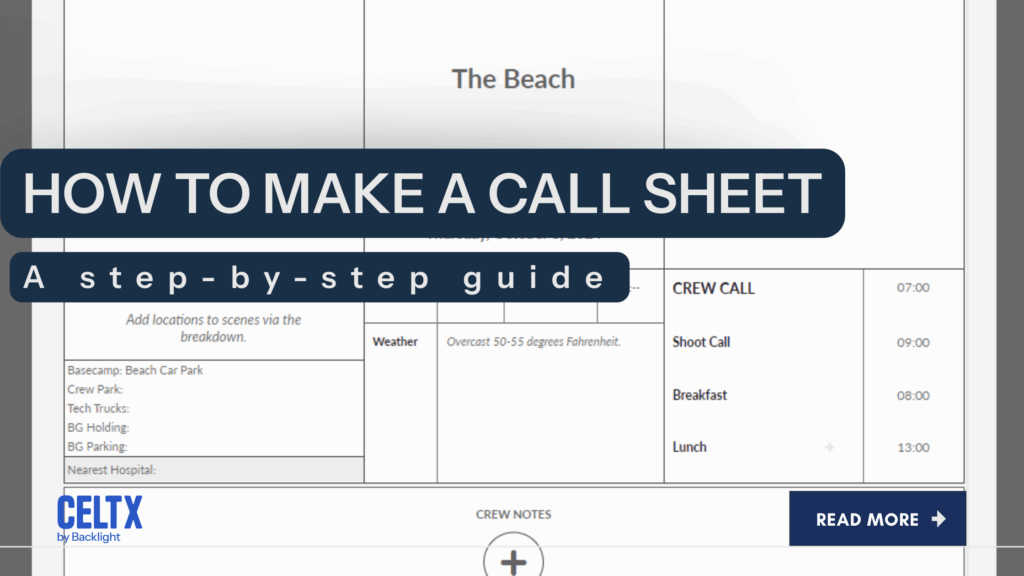
How to Make a Call Sheet: A Step-by-Step Guide
A strong plan is only useful if everyone knows where to be and when. Learn how to create a call sheet that keeps your corporate video shoot organized and running smoothly.