Stories love a good duo. From mismatched partners to symbiotic soulmates to two characters who don’t even realise they’re orbiting the same narrative sun, dual‑protagonist stories hit a deeply human sweet spot. We aren’t solitary creatures; we react, clash, mirror, deflect, collide. So, when a script chooses to place two people at the centre, the emotional and structural possibilities double.
And so do the ways it can go wrong.
A dual‑protagonist story is one of the most rewarding and delicate narrative structures you can choose. When it works, it sings. When it doesn’t, readers will swear one character is “the real protagonist” and the other is “extra,” or they’ll insist the story loses focus, or that it feels like two films glued together by the world’s most exhausted intern.
But you can do this. In fact, if you love relationship‑driven storytelling (which, let’s face it, you probably do), dual leads might be the most powerful structure in your toolkit.
In today’s blog, we’ll break down exactly how to use them without breaking your script.
So, let’s get into it!
Table of Contents
- What is a Dual Protagonist? (Definition and Key Differences)
- The Structural Secret to Balancing Two Lead Characters
- Symmetric vs. Asymmetric Arcs: Which Structure Fits Your Story?
- Famous Dual Protagonist Examples and Why They Work
- Dual Protagonist vs. Antagonist: Mapping the Shared Conflict
- How to Use Celtx to Track Parallel Character Journeys in Your Script
- Conclusion

What is a Dual Protagonist? (Definition and Key Differences)
A dual protagonist story has two characters who both function as the central force of the narrative.
Not a protagonist and a co‑lead. Not a protagonist and a particularly loud supporting character. Not a love interest who happens to hog the best lines. Two fully-fledged protagonists who each have:
- a goal
- an arc
- agency
- emotional stakes
- and a narrative role that cannot be removed without the story collapsing
Here’s a helpful question to test it:
If you removed one of them entirely, would the story still make sense? If yes, you don’t have a dual protagonist story: you have a main character and a glorified support.
Dual protagonists operate from two equally critical perspectives, and the film lives in the space between them: the tension, the contrast, the shared momentum.
This is what separates dual leads from other common pairings:
- Protagonist + Antagonist: Their goals oppose one another. The story escalates because they clash.
- Protagonist + Companion: The companion supports or highlights the protagonist’s arc but doesn’t have one of equal weight.
- Ensemble: No single character (or pair) owns the story; instead, multiple storylines weave together with roughly equal importance.
A dual‑protagonist narrative is tighter and more intertwined than an ensemble. The characters are bound by circumstance, goal, conflict, obligation, or emotional gravity.
If you want two characters to share the narrative, the story must treat both of them as indispensable.
Dual protagonists have also found their way into video games, with the most recent Assassin’s Creed release having mixed reviews for their use of two main characters.
The Structural Secret to Balancing Two Lead Characters
Writers often assume dual protagonists mean writing “two stories at once.” That’s how people end up with Franken-scripts: two disconnected arcs stitched together with the creative equivalent of dental floss and panic.
The secret to building a dual‑lead structure is that your protagonists from inciting incident to final image, can have separate arcs, but they must share the same plot.
The external spine of the story, such as the mission, trial, journey, or conflict is one unified thread. Both characters push it forward, complicate it, and are directly impacted by it.
But the internal arcs (the emotional engines) can diverge, contrast, reflect, or even contradict one another. Often, one character needs what the other fears. One is growing towards something the other is running from. One clings to a worldview the other is desperate to destroy.
It’s the interaction between these two arcs that creates the electricity.
In practice, this means:
- You don’t need “more plot” to compensate for two leads.
- You don’t need separate goals that operate on different tracks.
- You don’t need alternating sections of the film where one character “takes over.”
You need one story with two evolving perspectives. This is the difference between dual protagonists and two protagonists merely existing in parallel. Dual leads share a narrative container where they’re trapped together, whether literally, emotionally, or thematically.
If you treat your story like a single organism with two beating hearts, the structure becomes far more manageable.

Symmetric vs. Asymmetric Arcs: Which Structure Fits Your Story?
Once you accept that your protagonists share one story, the next choice is how their arcs relate. Dual‑protagonist narratives generally fall into one of two models.
Symmetric Arcs
Both characters have arcs of equal weight and similar shape. Their transformations mirror each other, sometimes directly, sometimes inversely.
Think Inside Out or Little Miss Sunshine, where the ensemble contains balanced arcs but also clear pairings that grow in parallel. In symmetric dual‑protagonist stories, the emotional journeys feel like two sides of the same coin. They might be learning the same lesson from different angles or confronting the same internal wound in opposite ways.
This structure works best when:
- The story is about partnership
- The theme is holistic (e.g. growth through connection, unity, reconciliation)
- The climax involves both characters acting in sync or equally contributing to the final shift
Asymmetric Arcs
This is where a lot of writers panic, because “asymmetric” sounds like one character is secretly the real lead. Not so.
In an asymmetric dual‑protagonist narrative, both characters are equally important, but their arcs serve different functions. One might move earlier, or more drastically, or more loudly—but the other provides the counterbalance that makes the story work.
Think Heat or Amadeus (yes, technically Salieri is the protagonist and Mozart the antagonist-foil, but structurally they operate as dual narrative centers). One character’s transformation illuminates or catalyzes the other’s, creating a dynamic tension loop.
Asymmetric arcs work beautifully when:
- The characters are deliberately contrasted
- The story centres on opposition, rivalry, or moral divergence
- The climax involves a decisive difference between their choices
Both symmetric and asymmetric structures are valid. What matters is consistency: whichever you choose, commit to it in every act.
Map your dual-arc in the Celtx Beat Sheet. Try Celtx for free today!
Famous Dual Protagonist Examples and Why They Work
You’ve seen dual protagonists succeed across genres even if you didn’t consciously recognize the structure.
Lilo & Stitch
Both characters are broken and eventually learn connection. Their arcs mirror each other, but from wildly different emotional starting points. The film works because their growth is co‑dependent; Stitch can’t evolve without Lilo, and Lilo can’t heal without Stitch.
Thelma & Louise
Two leads, one trajectory. Their arcs are symmetric in shape (both break free from oppression), but asymmetric in voice and intensity. The plot binds them together so tightly that separating them would be a crime.

Heat
Pacino and De Niro aren’t protagonist vs. antagonist. They’re dual leads locked in a professional and existential tango. Both arcs matter. Both choices matter. Their contrast is the narrative engine.
Up (Carl and Russell)
Yes, it’s technically Carl’s story, but structurally, Russell is more than a tag‑along. His emotional needs drive half the film’s heart. Carl teaches Russell how to connect; Russell teaches Carl how to let go. Their arcs resolve together in the climax.
Ant‑Man & The Wasp
Hope and Scott share the protagonist role. Their goals, skills, and emotional stakes intertwine to drive the story forward.
In every great dual‑lead example, the success comes down to one thing: the film isn’t about Character A or Character B but the space between them.
Zhang Chenjing explores dual protagonists in literature in their article Analysis of the Dual Narrative Structure in To Live.
Dual Protagonist vs. Antagonist: Mapping the Shared Conflict
The biggest source of confusion is mistaking a dual‑lead structure for a protagonist/antagonist relationship. Here’s the simplest way to distinguish them:
- Dual protagonists share a problem.
- Protagonist/antagonist pairs create the problem for one another.
Dual protagonists often:
- want the same external goal
- face the same central obstacle
- are trapped in the same situation
- affect each other emotionally
- but do not prevent each other from achieving the goal
Meanwhile, antagonists:
- oppose the protagonist’s goal
- escalate the obstacles
- force the protagonist’s change
- do not share the protagonist’s stakes
Dual protagonists can argue, clash, frustrate, challenge, or even resent each other, but they are never the obstacle. They may cause complications, but not the fundamental conflict.
This is crucial in outlining your story. If one character functions primarily as a barrier to the other, they’re fighting over the narrative, and that’s not what we want in this instance.
How to Use Celtx to Track Parallel Character Journeys in Your Script
Dual protagonists are both a creative and logistical challenge. You’re juggling two arcs, two emotional rhythms, two sets of stakes, and one shared plot. If you don’t track it visually, it’s far too easy to accidentally drop one lead for twenty pages and only realise during Draft 6 and a quiet cry into a tea mug.
Don’t worry, because Celtx can save you.
Use the New Celtx Beat Sheet
Dual-protagonist stories live or die by structure. When you have two characters evolving across the same plot, it’s incredibly easy for one arc to surge ahead while the other quietly flatlines for several scenes.
That’s where Celtx’s new Beat Sheet becomes a lifesaver. It gives you a bird’s-eye view of your story’s emotional and narrative spine, and you can use it to track both arcs without ever over-complicating the layout.
Start by building your external beats: the catalyst, midpoint, escalation, crisis, climax. These are the beats both protagonists share. Once that spine is in place, add a short line of text beneath each beat describing what’s happening internally for each character at that moment. Keep it lean and specific: something like “Alex rejects responsibility” or “Maya admits the truth to herself but not others.”
Because the Beat Sheet displays each beat in a clean, modular card, you can visually check whether your protagonists’ emotional journeys advance in tandem. If one character stops developing across a chunk of the sheet, the gap is impossible to miss.
You’ll quickly spot where you need to add a scene, adjust pacing, or realign the arcs so they feel intentionally woven rather than accidentally lopsided.
The real power of the Beat Sheet is how it keeps everything connected: two arcs, one plot. You’re not juggling separate index cards or opening two outlines in two tabs while quietly crying into your tea. Everything sits in the same structural container, exactly the way a dual-lead story should.
Check out our new beat sheet for all your story structure needs!

Use Character Tagging
Celtx’s character tagging using the catalog feature lets you see at a glance who appears where and how often. When you’re writing a dual‑lead script, balance is everything. You don’t need each protagonist to appear in exactly 50% of scenes, but the story’s weight should feel evenly distributed.
Tag their appearances, check the scene breakdown, and you’ll immediately spot:
- an over‑weighted act
- a missing emotional beat
- uneven pacing between arcs
This makes the editing process much faster, and it keeps you honest about whether both characters are truly “co‑leads.”
Conclusion
A dual‑protagonist story isn’t just “a story with two important characters.” It’s a deliberate structural choice that shapes the emotional, thematic, and narrative spine of your script. When you understand that both characters share the plot but carry their own internal journeys, the whole thing clicks. Symmetry or asymmetry, harmony or contrast, friendship or friction all works, as long as both arcs matter and both characters actively drive the story.
The space between two protagonists is one of the richest landscapes in storytelling. If you can map it, track it, and balance it, you unlock a narrative engine that’s bigger and more complex than anything a single lead can offer.
And Celtx is genuinely built for this kind of structure. Whether you’re mapping parallel arcs in a multi‑column layout or tracking appearances with character tagging, it gives you the clarity you need to keep both stories beating in rhythm.
Ready to sketch it all into place?
Develop stronger characters.
Try the Celtx character tool – free with your Celtx account!
Up Next:
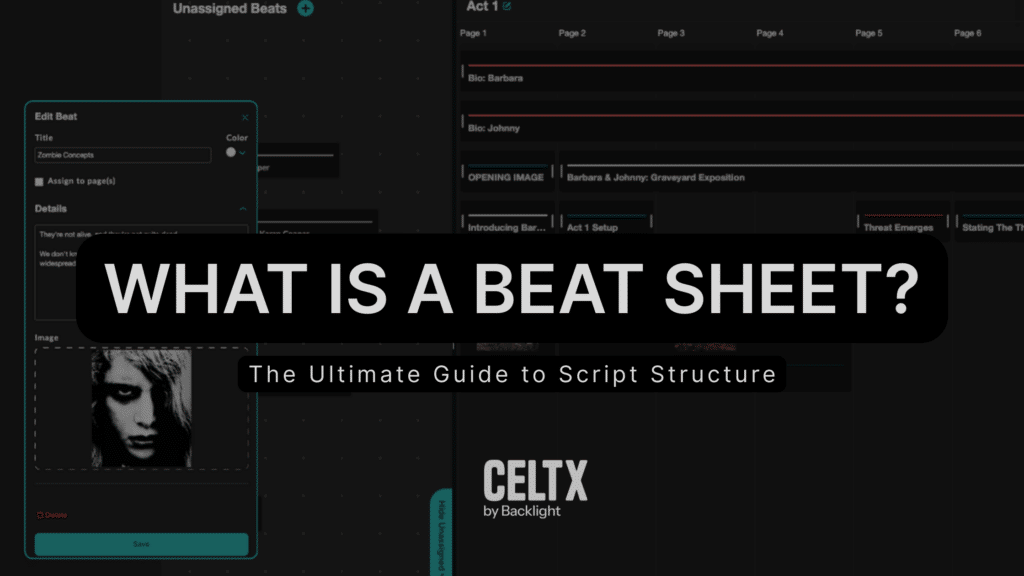
What is a Beat Sheet? The Ultimate Guide to Script Structure
Balancing dual protagonists often comes down to structure. Learn how beat sheets help you map character arcs, track key moments, and keep both storylines moving in sync.