A character stands alone and says what they would never admit to anyone else. That’s the power of a soliloquy. It gives an audience access to a character’s private thoughts, exposing fears, desires, doubts, and contradictions that might otherwise remain hidden.
Soliloquies are associated with theatre, particularly Shakespeare, but the technique is not limited to characters speaking under a spotlight. Modern films and television series use similar devices through direct address, voice-over, video diaries, confessionals, recorded messages, and private speeches.
Used well, a soliloquy can deepen character, sharpen a turning point, or reveal the emotional truth beneath the action. But used poorly, it can become an information dump that explains what the story should have shown.
In today’s blog, we’ll explore what makes a speech a soliloquy, and how us screenwriters can use the technique without making a script feel overly theatrical.
So, let’s get into it!

What Is a Soliloquy?
A soliloquy is a speech in which a character expresses their private thoughts aloud, usually while alone or behaving as though no one else can hear them.
Its purpose is not simply to deliver information, but to allow the audience to witness the character thinking.
In a strong soliloquy, the character is often wrestling with something rather than presenting a polished conclusion. Their thoughts may shift as they speak. They can question themselves, contradict themselves, rehearse an action, justify a decision, or reach a new understanding.
A soliloquy might reveal:
- what the character truly wants
- the fear beneath their behavior
- a secret plan
- a moral conflict
- the gap between their public persona and private self
- a decision that changes the story
In Hamlet, the titular character’s “To be, or not to be” speech is not just a statement about death but portrays a mind caught between suffering, fear, action, and uncertainty. The dramatic interest comes from the struggle inside the speech.
Soliloquy vs Monologue vs Dialogue
Soliloquies, monologues, and dialogue all involve spoken words, but they serve different functions. Let’s take a closer look at each of them:
Soliloquy
A soliloquy reveals a character’s private thoughts. The character is usually alone, speaking to themselves, the audience, or an imagined listener. The focus is internal.
Monologue
A monologue is an extended speech delivered by one character, usually to another character or group. The speaker may tell a story, make an argument, confess, give instructions, or persuade someone. Unlike a soliloquy, a monologue doesn’t have to reveal private thoughts.
Dialogue
Dialogue is a verbal exchange between two or more characters. It’s shaped by response, interruption, conflict, evasion, and reaction.
Aside
An aside is a short remark a character makes directly to the audience, or to themselves, that the other characters in the scene supposedly can’t hear. Unlike a soliloquy, an aside is brief, often just a line or two, and the scene keeps moving around it instead of pausing for it.
Take a courtroom closing argument. This is more likely to be a monologue. A character debating whether to betray a friend while alone is delivering a soliloquy. Two friends arguing about that betrayal are engaged in dialogue. If one of them mutters “she’s lying” under her breath so only the audience catches it, that’s an aside.
There can be overlap. A character may begin a monologue addressed to someone else, then become so emotionally exposed that it starts to feel like a soliloquy. The clearest question to ask yourself is: who is this character really speaking to?
Famous Soliloquy Examples
The most famous soliloquies often place a character at a point of decision.
“To be, or not to be” | Hamlet
Hamlet considers suffering, death, fear, and the uncertainty of what comes after. The speech is powerful because it does not deliver a neat answer. It dramatizes indecision.
“Is this a dagger which I see before me?” | Macbeth
Before murdering King Duncan, Macbeth sees (or imagines) a dagger leading him towards the act. The soliloquy turns psychological conflict into a visual image and carries the audience into his fear, ambition, and collapsing sense of reality.
“Now is the winter of our discontent” | Richard III
“O Romeo, Romeo” | Romeo and Juliet
Juliet believes she is alone as she questions why Romeo must belong to the rival Montague family. Romeo overhears her, but she does not know he is present. Dramatically, it functions as a soliloquy because she believes her thoughts are private.
These examples remain effective because each speech does more than explain the plot. It exposes a character in conflict with themselves, their circumstances, or the world.
How Modern Screenwriters Use Soliloquies
Screenwriting is a visual form, so characters rarely stand alone and speak uninterrupted for several minutes. However, modern writers still use the core function of the soliloquy: giving the audience privileged access to a character’s inner life.
Direct Address
A character may speak directly to the camera, treating the audience as a confidant. This can create intimacy, comedy, discomfort, or complicity.
In Fleabag, the lead regularly turns to the audience with comments other characters can’t hear. Many are technically asides rather than full soliloquies, but together they perform a similar function. They reveal the private self she hides behind humor and control.
Direct address becomes especially powerful when the device changes. If a character who normally speaks confidently to the audience suddenly can’t look at the camera, the silence can reveal more than another speech.
Voice-Over
Voice-over can allow the audience to hear a character’s memories, judgements, fantasies, or private narration. It becomes soliloquy-like when it exposes an active inner conflict rather than describing what is already visible.
“I was nervous” adds little if the character is visibly shaking. “I had spent ten years waiting for this moment, and now I wanted the door to stay closed” creates contradiction and depth.
Recorded Messages and Diaries
Video diaries, audio recordings, unsent messages, therapy exercises, prayers, and letters can create a believable reason for a character to speak alone.
The recording should feel like something this character would genuinely make, not a device invented solely to explain the backstory.
Private Rehearsal
A character may practice a proposal, apology, lie, speech, or confession before facing someone. This reveals both what they intend to say and what they’re afraid to say. The later conversation can create dramatic contrast when reality goes differently.
Speaking to an Absent Person
A character might talk to a photograph, a grave, an empty chair, a sleeping partner, or someone in a coma. Although another figure may be physically present, the speech remains private because no genuine exchange is possible.
This works best when the imagined listener has emotional significance. The speech then becomes a relationship scene as well as an expression of inner thought.
Before and After Example: Weak vs Strong Soliloquy
Imagine a detective who discovers that her missing sister may have been involved in the crime she is investigating.
Weak Version
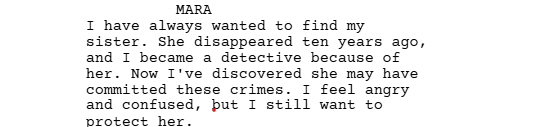
The speech communicates the information, but it sounds like a summary written for the audience. Mara already understands exactly how she feels, and nothing changes while she speaks.
Stronger Version

This version doesn’t explain every detail but instead uses specific memories, physical action, pauses, and contradiction. Mara begins by blaming her sister, then reveals how deeply she has built her identity around believing in her innocence.
It also leaves room for the actor and audience to interpret what she can’t say.
When Not to Use a Soliloquy
A soliloquy is not always the best way to reveal inner thoughts. Let’s take a look at some of the circumstances where one just isn’t needed:
The Action Already Communicates the Emotion
If a character deletes a voicemail, removes a wedding ring, and places it beside a packed suitcase, a speech explaining that the relationship is over may weaken the scene.
The Character Is Summarizing Backstory
Audiences can sense when someone is speaking for their benefit. Backstory should also emerge through choice, conflict, behavior, and carefully selected details.
The Speech Stops the Story
A long speech in the middle of urgent action can drain tension unless that pause is dramatically important.
The Character Has No Reason to Speak Aloud
Some characters naturally talk to themselves, others don’t. A soliloquy should suit the character, tone, and world.
The Speech Contains No Change
The best soliloquies move. A character might begin certain and end doubtful, start afraid and become resolved, or try to justify themselves before realizing the truth. If they finish in the same emotional position in which they started, the speech may be unnecessary.
Quick Exercise: Reveal Character Through Inner Thoughts
Choose a character who is about to make an important decision.
Write down:
- What do they want others to believe?
- What do they secretly fear?
- What truth are they avoiding?
- What object or image could trigger those thoughts?
- How will their emotional position change?
Now write a soliloquy of no more than 150 words.
Don’t begin with, “I am scared because…” Let the character circle the truth. Give them something specific to react to, such as a photograph, bloodstain, ticket, voicemail, or unopened letter.
Once it’s written, cut any line the audience could understand from the visuals alone.
Write your soliloquy in Celtx’s script editor, formatted and ready for a table read.

FAQ
No. While the term is strongly associated with theatre, the technique can appear in film, television, novels, audio drama, games, and other forms. Screen stories often adapt it through direct address, voice-over, private recordings, or speeches to absent characters.
A monologue is any extended speech by one character. A soliloquy is a specific type of speech that reveals private thoughts, usually when the character is alone or believes they can’t be heard.
Yes. A film can include a traditional spoken soliloquy, but screenwriters often use more cinematic versions. Direct-to-camera speech, voice-over, rehearsed conversations, confessionals, and private messages can serve the same purpose.
No. It can last several pages or only a few lines. Length is less important than function. It must provide access to thoughts the character would not normally share.
Not necessarily. Characters often misunderstand, disguise, or resist their emotions. A more interesting soliloquy may reveal the truth indirectly through contradiction, metaphor, hesitation, or what the character refuses to say.
Conclusion
A soliloquy gives the audience access to the private battle beneath a character’s public behavior. Although the technique has deep roots in theatre, its dramatic purpose remains useful for modern screenwriters. Direct address, voice-over, recordings, rehearsals, and speeches to absent people can all create contemporary forms of soliloquy.
The key is to treat the speech as action. The character should be searching, resisting, deciding, confessing, or changing as they speak. Don’t use a soliloquy simply because you need to explain something. Use it when hearing the character’s private thoughts creates an experience that action or dialogue alone can’t provide.
Reveal character through every line.
Write stronger dialogue and richer characters with Celtx’s script editor.