Writer’s block has a flair for drama. It doesn’t usually arrive quietly but kicks the door down somewhere around Act Two, throws your confidence out the window, and announces that your story is, in fact, terrible.
Suddenly, the script you were excited about becomes a suspicious document full of bad choices. The characters stop talking. The plot stops moving. Even the scene heading starts looking judgmental. This is where a beat sheet can help. You may have heard of the famous 15-beat Save the Cat beat sheet from Blake Snyder.
Not because beat sheets are magical; they aren’t. They won’t make coffee, silence your inner critic, or turn a vague dragon-warrior-romcom idea into a studio-ready masterpiece by Friday. But they can do something just as useful: they can make the problem smaller.
When a script feels impossible, a beat sheet gives you a way back in. It turns the giant, foggy question of “How do I write this whole story?” into something far less terrifying: “What happens next?”
In today’s blog, we’ll be uncovering the beat sheet and how it can transform your writing process.
Let’s begin…
Table of Contents
- Why Writer’s Block Happens
- Why “Just Write” Isn’t Helpful Advice
- How Beat Sheets Break Big Problems into Small Ones
- Using Beats to Diagnose Story Problems
- Using Beat Sheets to Restart a Stalled Draft
- Beat Sheet Exercise You Can Try Today + Free Template
- How to Beat Writer’s Block with the Celtx Beat Sheet
- FAQs
- Conclusion

Why Writer’s Block Happens
Writer’s block is often treated like a mysterious curse, but a lot of the time it’s your brain waving a little red flag.
Sometimes you’re blocked because you don’t know what your character wants. Sometimes the stakes are too vague, your first act has promised one story and your second act is trying to deliver another, and sometimes you’re avoiding a difficult scene because you know, deep down, it exposes a weakness in the whole draft.
Yes, it’s annoying, but it can be very useful too.
Writer’s block often happens when the story has stopped making sense to you. You may not be able to articulate why yet, but you can feel it. The energy drops, the scenes become harder to write, and you start adding conversations that sound important but don’t actually change anything. The script becomes a waiting room. And that’s where the beat sheet comes in.
Why “Just Write” Isn’t Helpful Advice
“Just write” is one of those pieces of advice that sounds motivational until you’re the person staring at page 47 wondering if your entire plot is held together with string and denial.
Yes, writing is important. Obviously. At some point, words have to go on the page. But “just write” is not always helpful because it assumes the problem is laziness or fear. Sometimes the problem is structural. Sometimes the story engine is broken.
If your car won’; start, “just drive” isn’t advice but complete nonsense. A blocked writer doesn’t always need more discipline. Sometimes they need a clearer path.
A beat sheet helps you step back and ask practical questions:
- Where does the story turn?
- What is the midpoint doing?
- Is the protagonist making active choices?
- Are the stakes escalating?
- Does the ending pay off the beginning?
That kind of clarity can get you moving again faster than bullying yourself into another unfocused scene.
How Beat Sheets Break Big Problems into Small Ones
The biggest reason beat sheets help with writer’s block is that they reduce overwhelm.
A screenplay is a huge task while a beat isn’t. A beat is simply a key story moment: a decision, a discovery, a reversal, a failure, a victory, a shift. Basically, one step in the larger journey.
A good beat sheet shows the progression of the story. It doesn’t need to include every line, every scene, or every clever visual idea you have scribbled in your notes app at 1:12 a.m. It just needs to track the major movements.
What changes? What gets worse? What choice does the character make? What new problem does that choice create?
This is where beat sheets are especially useful for screenwriters. Film and TV writing depends on momentum. Scenes need to connect, pressure needs to build, and the audience needs to feel that each moment is leading somewhere.
When you break the story into beats, you can stop trying to solve everything at once. You solve one movement, then the next, then the next. Suddenly, the impossible draft becomes a much more manageable.
It’s still difficult, of course, but manageable difficult is much better than staring-into-the-void difficult.
Break through writer’s block with Celtx Beat Sheets.

Using Beats to Diagnose Story Problems
A beat sheet can help you figure out where your story has gone wrong.
Start by writing down the major beats of your current draft and be brutally honest with yourself. If a section is just “they talk about the plan again,” write that. The beat sheet is not here to flatter you. Once the story is laid out, patterns become visible.
Maybe your protagonist disappears emotionally for ten pages. Maybe the midpoint doesn’t change the direction of the story. Maybe the antagonist is not applying enough pressure. Maybe the final act depends on a revelation you forgot to plant. Maybe three scenes in a row do the same job, which is very rude of them.
Beat sheets are excellent at exposing repetition. If several beats have the same function, you may not need all of them. If there is a long gap where nothing escalates, you have found where your problem lies. If your character never makes a choice that costs them something, you may have a passivity problem.
The point is not to punish the draft but to understand it for what it’s. Once you can see the problem, you can fix it.
Using Beat Sheets to Restart a Stalled Draft
If you’re stuck mid-draft, don’t always force yourself to continue from the exact scene where you stopped.
Step back and get creative. Structure a simple beat map from the beginning to where you’re now. Then continue the map beyond the stuck point using rough, imperfect beats. Ask:
- What does the character want at this point?
- What has changed since the beginning?
- What pressure are they under?
- What choice are they avoiding?
- What is the next event that forces movement?
If your character needs to confront someone in Act Three, what beat forces them to stop avoiding it? If your hero needs to fail before they change, what choice leads to that failure? If your ending depends on a sacrifice, where does the story teach us what that sacrifice means?
A beat sheet lets you build a bridge over the gap. Even if the beats are messy, they give you something to react to. And reacting is often easier than inventing from nothing.
You can always improve the beats later. The first job is to get the story breathing again.
Beat Sheet Exercise You Can Try Today + Free Template
Here is a simple exercise for getting unstuck. Open a blank document and write just ten numbered beats. This isn’t the time for a 40-page outline.
Use these prompts:
- Who is the protagonist at the start?
- What do they want?
- What disrupts their normal world?
- What choice pulls them into the main story?
- What early success or failure changes their approach?
- What midpoint event raises the pressure?
- What is their lowest point?
- What do they finally understand or refuse to understand?
- What choice defines the climax?
- What has changed by the end?
Keep each answer to one or two sentences. If you can’t answer one, that may be where the story is weak, and that’s a good thing as you have an opportunity to fix it.
Then look at the ten beats together. Do they feel connected? Does each one lead naturally to the next? Does the character’s journey build? Do the stakes grow? Does the ending feel like the result of the beginning?
This exercise won’t solve every problem, but it can show you where to focus. And when you know where to focus, writing feels less like wandering in a fog with a broken torch.
Stuck on your next scene? Use our printable Beat Sheet Template to map your story’s key turning points, diagnose what is not working, and find your way back into the draft one beat at a time.
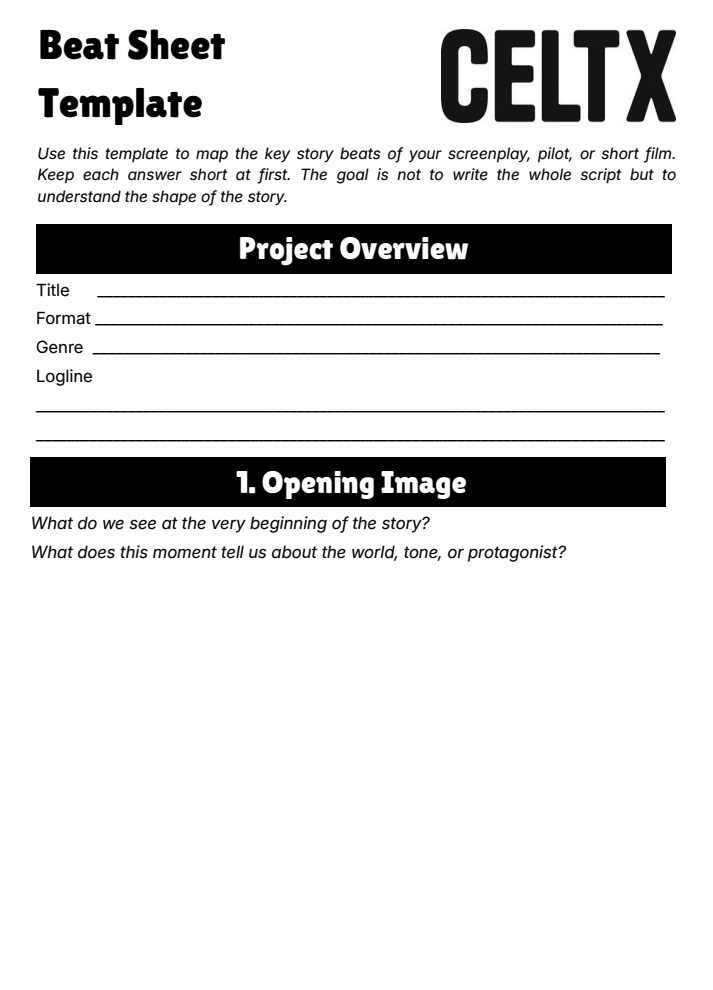
Click here to download our free Beat Sheet Template
How to Beat Writer’s Block with the Celtx Beat Sheet
The Celtx Beat Sheet beats writer’s block by connecting your unstructured brainstorming directly to your script’s timeline. Instead of leaving your ideas on scattered sticky notes, this integrated tool lets you outline, color-code, and drag your story beats directly into your screenplay pages.
By bridging the gap between a blank page and a structured draft, Celtx ensures you never lose your creative momentum. Here is how to use the tool to break your block:
1. Dump Your Ideas into the Unassigned View
When you hit a creative wall, do not force yourself to write chronologically. Instead, open the Celtx Beat Sheet and focus on the Unassigned View on the left-hand side of your canvas.
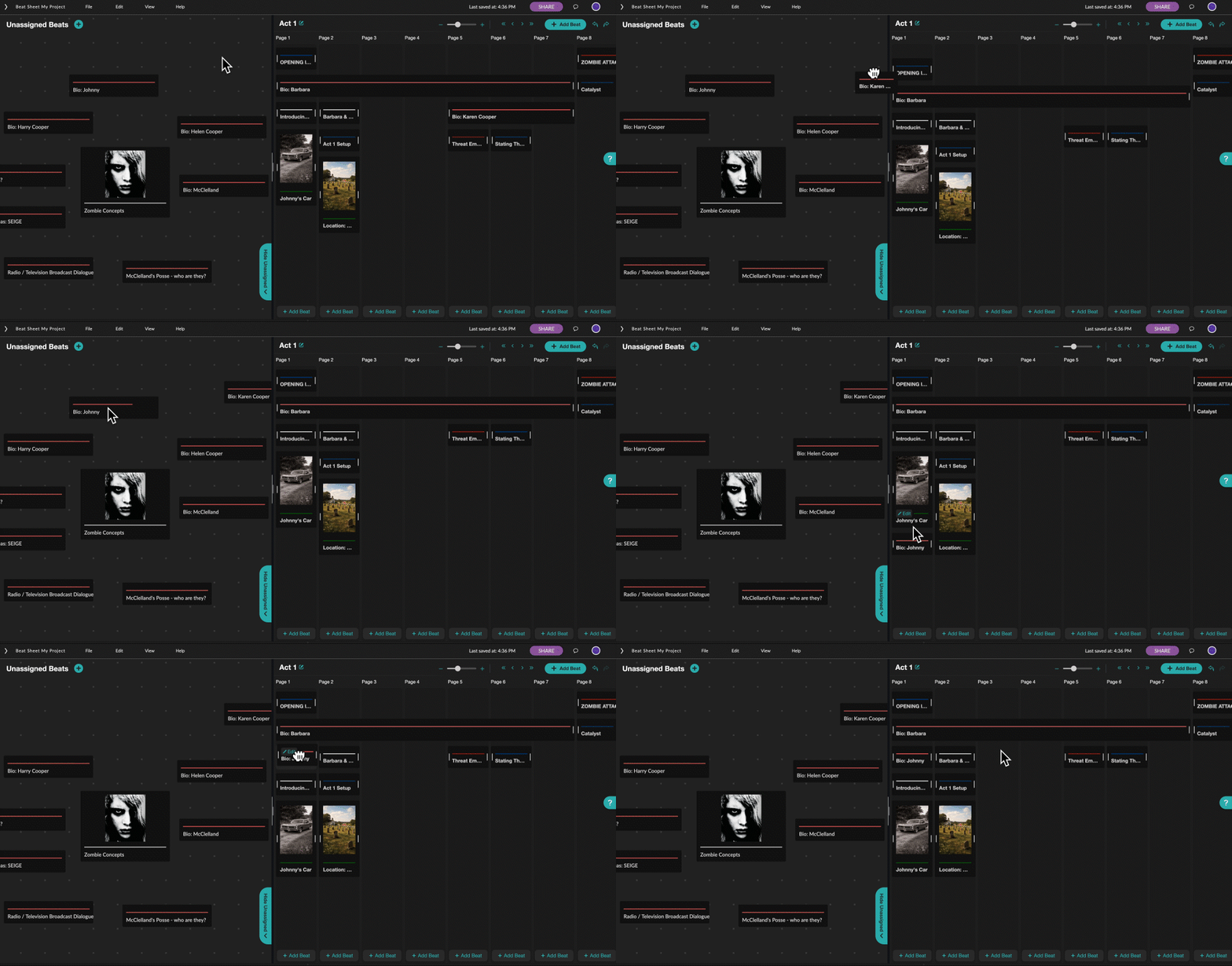
This area acts as your unstructured creative scratchpad. Click the “+” button to quickly dump random thoughts, fragments of dialogue, or visual concepts onto individual “cards”. You can even upload mood board images directly onto your cards to give your ideas visual weight.
2. Group, Color-Code, and Map Your Arcs
Once your raw ideas are out of your head, use visual organization to find the structure. You can color-code your cards to track different character arcs, subplots, or thematic threads. If you have two contrasting plotlines, giving each a distinct color will instantly show you if one is quietly flatlining.
3. Drag and Drop Your Story into Place
When a sequence begins to make sense, transition your cards from the free-form scratchpad into the Beat Sheet Grid on the right. Left-click, hold, and drag your unassigned cards directly into the specific page columns.
The grid organizes your pages into clearly defined Acts. If an idea or a dramatic set piece spans multiple pages, simply click and drag the outer handle of the card to stretch its duration across the timeline.
4. Write Directly Alongside Your Outline
The biggest advantage of Celtx is that your outline and your draft live in the exact same workspace. When you are ready to write, open the Beats Panel directly inside your script editor.
You can read your beats as you type your scene headings and action lines. If you want to jump to a specific part of your story, click the “Navigate to Editor” icon on any card, and the software will instantly focus your script to that exact page.
FAQs
Yes, many professional writers use beat sheets, outlines, treatments, cards, boards, or some form of story mapping. The exact method varies, but professional writing often involves planning because scripts need structure, momentum, and clarity.
A beat sheet is simply one practical way to organise the story before or during the draft.
Absolutely. Beat sheets are especially useful during rewrites because they let you see the story as a whole. You can identify repeated scenes, missing turns, weak stakes, passive character choices, or sections where the pacing drops.
Sometimes rewriting becomes much easier once you stop looking at individual pages and start looking at the story’s movement.
Then don’t treat a beat sheet like a prison sentence. Use it lightly. You don’t need to plan every detail before writing. Some writers discover the story as they go, and that’s fine. A beat sheet can still help you when you get stuck, lose focus, or need to check whether the draft is holding together.
Detailed enough to be useful, but not so detailed that it kills your desire to write the script. For early development, a short list of major beats may be enough.
For rewrites, you may want a more detailed scene-by-scene version. The best beat sheet is the one that helps you see the story clearly.
Only if you use it formulaically. A beat sheet is a tool, not a rulebook. It should help you understand cause and effect, escalation, and character change. The originality comes from your characters, voice, world, choices, and emotional point of view.
Conclusion
Beat sheets won’t write your script for you. But what they can do is help you find your way back when the story feels too big, messy, or too impossible to continue. They break the work into smaller pieces, reveal what’s missing, and help you diagnose structural problems without spiralling.
So, the next time your script stalls, don’t just sit there waiting for inspiration to arrive in dramatic lighting. Step back, map the beats, find the next turn, and give yourself one small story problem to solve. Then write one beat at a time.
Stop staring at a blank page and start mapping your story with Celtx.
Use our integrated Beat Sheet to brainstorm freely, organize your acts, and drag your ideas directly into your script’s timeline.
Up Next:
What is a Beat Sheet? The Ultimate Guide to Script Structure
Outlining shouldn’t strangle your creativity. Discover how a professional beat sheet tracks your story’s emotional rhythm and pacing to keep your writing focused and purposeful.