Every production starts with a script, but it only becomes a film when people enter the picture.
Directors, actors, producers, assistants, technicians, designers, coordinators, and dozens of specialists all come together to transform a written story into something visual and alive. The magic of filmmaking depends on collaboration, but collaboration comes with a logistical nightmare.
- Who’s available on which day?
- Where are the contracts stored?
- Which version of the call sheet is the latest one?
- Who actually has the actor’s headshot?
These are the kinds of questions that can derail a production before the cameras even roll. When information about cast and crew is scattered across spreadsheets, email chains, messaging apps, and folders on different computers, the production office becomes chaotic.
This is where centralized production management becomes essential. With a platform like Celtx, teams can store, organize, and connect every piece of talent information in one place. Instead of juggling disconnected tools, producers can manage casting details, crew roles, contracts, headshots, and scheduling data through a single workflow.
The result is a production environment where communication is clearer, logistics run smoother, and everyone knows exactly where to find the information they need.
In today’s blog, we’ll explore how centralized talent management works and how you can set it up in Celtx to keep your production running like a well-oiled machine.
Table of Contents
- The Cast & Crew Problem: The Scattered Production Office
- Why Centralized Production Management Saves Time and Money
- Free Production Management Workflow Guide
- Step-by-Step: Setting Up Your Cast and Crew in Celtx
- How to Sync Your Talent Data with Call Sheets and Reports
- Managing Talent Logistics: From Headshots to Contracts
- Managing Large Productions in Celtx
- Common Casting and Crewing Bottlenecks
- FAQ
- Conclusion
The Cast & Crew Problem: The Scattered Production Office
Most production chaos happens in the office rather than on set.
Before cameras roll, the production team is already managing dozens, sometimes hundreds of people. Actors need contracts and headshots stored. Crew members must be assigned roles and departments. Schedules need to sync with call sheets. Union rules, contact details, and availability all have to be tracked.
Without a centralized system, productions typically rely on a patchwork of tools:
- Google Sheets for crew lists
- Email threads for contracts
- Shared drives for headshots
- Messaging apps for scheduling changes
- Separate scheduling software for call sheets
Each tool works in isolation, which means information quickly becomes inconsistent.
One assistant might update a spreadsheet with a new phone number, while another sends a revised call sheet that still contains the old one. A director might have an outdated headshot for an actor. The producer might not know that a crew member’s availability has changed.
The larger the project becomes, the worse this problem gets. Independent short films might manage with a few spreadsheets, but once a production includes multiple departments, dozens of actors, and overlapping shooting schedules, disorganization starts costing real time and money.
When critical talent data is scattered across different systems, simple tasks become frustrating detective work. Centralizing this information solves that problem.
Why Centralized Production Management Saves Time and Money
Film production runs on tight schedules and tighter budgets. Every inefficiency compounds quickly, especially when managing talent. Centralized production management changes the workflow in three key ways.
1. Eliminates Duplicate Work
When cast and crew data lives in a single platform, updating information once automatically updates it across connected tools. Instead of manually copying contact details between spreadsheets and call sheets, the system keeps everything synchronized.
2. Improves Communication
When every department accesses the same data source, confusion disappears. Production assistants, assistant directors, producers, and coordinators all reference the same talent records, ensuring everyone works from identical information.
3. Reduces Administrative Risk
Contracts, release forms, and personal data are too important to leave buried in email attachments. A centralized platform keeps these documents organized and accessible whenever the production team needs them. In practical terms, this means:
- Faster call sheet generation
- Fewer scheduling conflicts
- Clearer communication between departments
- Less time spent tracking down missing information
For producers and line producers, these efficiencies translate directly into cost savings. When the administrative side of production runs smoothly, the creative team can focus on storytelling instead of paperwork.
Free Production Management Workflow Guide
Looking for a clearer way to organize your production workflow? Check out our Production Management Workflow Guide to see how tasks like casting, scheduling, and crew coordination connect throughout pre-production and filming.
Use it as a reference while setting up your production inside Celtx.
Click here to download the Celtx Production Management Workflow Guide.
Step-by-Step: Setting Up Your Cast and Crew in Celtx
Getting started with centralized talent management in Celtx is surprisingly straightforward. The platform is designed so producers can build a complete cast and crew database that connects with other production tools like scheduling and call sheets.
Here’s how to set it up.
Step 1 | Create Your Production Workspace
Begin by creating a new production project inside Celtx. This workspace will become the hub where all your production data lives.
To do this, simply click CREATE, choose the type of project you want to start, name it, and then click CREATE PROJECT to confirm.


Within the project dashboard, you’ll find sections dedicated to script breakdowns, scheduling, reports, and talent management. This structure ensures every piece of information, from scripts to call sheets, remains linked.
Step 2 | Add Your Cast Members
Navigate to the cast management section and begin adding your actors.

You’ll see three sub-sections appear: Cast, Crew, and Vendors. Click on the + sign in CAST to add a new cast member.

Next, type the name of the actor and ensure that ACTOR is selected from the department drop-down menu. Once you’re happy click OK.

Now the cast member will appear in your cast list. You’ll now need to add extra information. To do that, simply click on their name, and their cast profile will appear.


Each cast profile typically includes:
- Actor name
- Character name
- Contact information
- Representation details
- Headshots and media files
Because these profiles become connected to scheduling tools later, it’s important to enter accurate information from the start.
Once your cast list is created, it becomes easy to reference actors throughout the production pipeline.
Step 3 | Build Your Crew List by Department
Next, populate the crew database by repeating the above steps, just in the crew section of your database.

Most productions organize crew members by department, such as:
- Camera
- Lighting
- Sound
- Production design
- Makeup and wardrobe
- Production management
Grouping crew by department helps assistant directors and coordinators quickly identify the right personnel when preparing call sheets or schedules.
Each crew profile can include roles, contact information, contracts, and additional documentation. It’s important to add as much information as possible as early as you can in each person’s profile to save any headaches later.
Step 4 | Connect Talent to Scheduling and Call Sheets
Once the database is built, the real power of centralized management appears.
Because the cast and crew list is connected to the production schedule, Celtx can automatically pull talent information into call sheets and reports.
This reduces manual entry and eliminates many of the common errors that occur when information is copied between tools.
Prefer a video guide? Well, there’s one right here:
How to Sync Your Talent Data with Call Sheets and Reports
One of the most time-consuming tasks in production management is preparing call sheets. But like many other processes, we’ve streamlined it for you in Celtx.
Once you’ve created your cast and crew list and are ready to import into your call sheet, simply follow these steps.
First, click SCHEDULE on the left-hand menu.

Then click the right-hand CALL SHEETS AND REPORTS tab at the top of the screen.

The call sheet screen will then appear. Create a new call sheet or click on a pre-existing one.

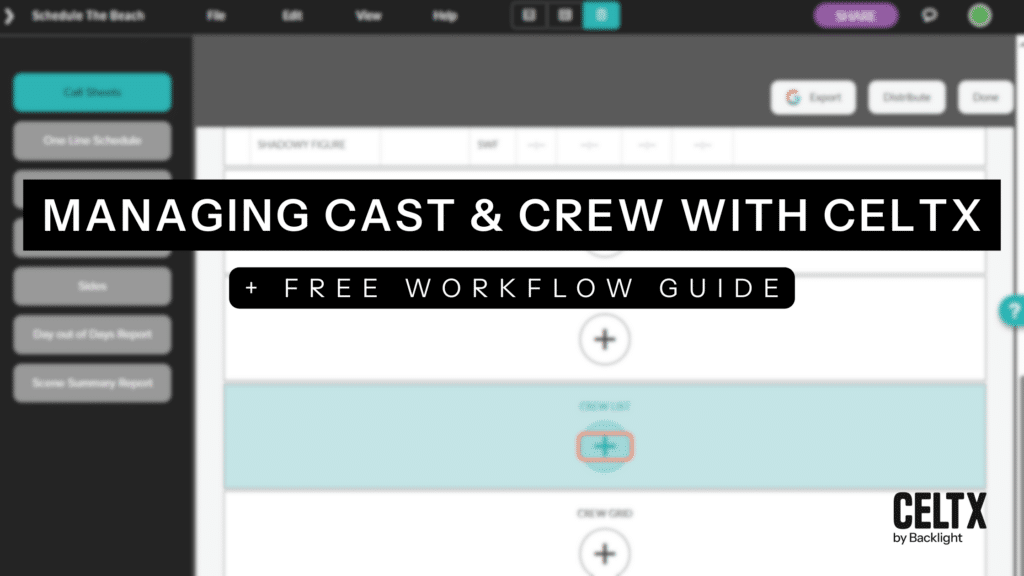
Scroll all the way down to the bottom of the call sheet until you find CREW LIST. Click on the + symbol.

Make sure all the crew needed for that day are highlighted, then click SAVE.


Now your whole crew list will be populated in the call sheet, ready to go.

The cast list will be automatically populated according to your shooting schedule.
Ready to create your own cast & crew database?
Try Celtx for free today!
Managing Talent Logistics: From Headshots to Contracts
Beyond scheduling and contact lists, talent management also involves a surprising amount of documentation.
Actors typically require headshots, resumes, contracts, release forms, and sometimes union paperwork. Crew members may also need employment contracts, NDAs, or certification records depending on the role.
Managing these documents manually often leads to confusion. Files get buried in shared drives, and production assistants spend valuable time searching for the correct version.
Centralized platforms simplify this process by linking documents directly to each talent profile.
When you open an actor’s profile in Celtx, you can immediately view:
- Headshots and media assets
- Contracts and legal documents
- Representation details
- Contact information
This approach transforms the talent database into a complete production reference system.
For producers, this is particularly valuable during pre-production. Casting decisions, contract negotiations, and talent availability all happen in quick succession. Having every relevant document attached to a single profile prevents delays and miscommunication.
It also helps when preparing marketing materials or press kits later in the production cycle.
Managing Large Productions in Celtx
Large productions introduce additional complexity.
Feature films, television series, and high-end commercials may involve hundreds of crew members and dozens of actors working across multiple shooting locations. Managing that scale requires more than simple spreadsheets.
Celtx addresses this challenge by organizing talent into structured databases connected to other production tools. Departments can be clearly defined, making it easier to filter crew members by role or responsibility.
For example, an assistant director preparing a call sheet can quickly pull in only the departments needed for a specific shooting day. Meanwhile, producers can generate reports that list all cast members involved in a sequence or location.
Large productions also benefit from shared access. Multiple team members can work within the same system simultaneously.
Instead of passing documents back and forth, the production team collaborates in a shared environment where updates appear instantly.
This kind of coordination becomes essential when productions scale beyond a handful of crew members.
For more production resources, check out SAG-AFTRA’s guide.
Common Casting and Crewing Bottlenecks
Even experienced production teams run into recurring challenges when managing talent.
1. Incomplete Information
When actors or crew members are added to a project quickly, their profiles may lack contact details, documentation, or role assignments. This leads to confusion later when schedules and call sheets rely on that information.
2. Version Control
If multiple team members maintain separate lists of cast and crew, discrepancies appear almost immediately. One list may include a newly hired gaffer while another still lists the previous hire.
3. Communication Breakdowns
Communication breakdowns are also common when departments rely on separate systems. The production office might have one set of contact details while the assistant director’s team works from another.
Centralized production management helps eliminate these problems by enforcing a single source of truth. When the entire team works within the same system, information becomes consistent across departments.
The earlier this structure is implemented in pre-production, the smoother the rest of the project becomes.
FAQ
Celtx allows productions to store and organize talent profiles in a searchable database. This makes it easier to manage large ensembles and quickly find specific actors or crew members when preparing schedules or call sheets.
Yes. Because call sheets pull information from the centralized talent database, updates to contact details or profiles can be reflected across production documents.
Absolutely. While larger productions benefit from automation and synchronization, smaller teams gain clarity and organization by keeping all production data in one place.
Conclusion
Managing cast and crew is one of the most complex administrative tasks in filmmaking. It requires tracking contact details, contracts, headshots, schedules, and department assignments for dozens or even hundreds of people.
When this information is scattered across spreadsheets and email threads, production quickly becomes chaotic.
Centralized production management changes that dynamic. By storing and connecting talent data in one platform, tools like Celtx allow producers to streamline communication, reduce administrative errors, and generate key documents like call sheets with far less effort.
When the production office runs smoothly, the creative team can focus on what actually matters: telling the story.
Take control of your production
Start managing your cast and crew in Celtx for free.
Up Next:

How to Create a Shooting Schedule: The Essential Guide
Once your cast and crew are organized, the next step is coordinating when everyone needs to be on set. Learn how to build a shooting schedule that keeps your production running smoothly.