![Graphic that reads, "Jobs in film: What is a line producer [the COO of film production]"
The Celtx logo is centered at the bottom of the image.](https://m8p8v8q3.delivery.rocketcdn.me/wp-content/uploads/2025/12/how-to-become-a-line-producer-2048x1152.png.webp)
Every film set has two parallel universes. In one universe, the director is chasing performance, the cinematographer is shaping light, and the writer is praying no one changes their favorite line. In the other universe, someone is staring at a spreadsheet that determines whether any of that happens tomorrow. That person is the line producer.
A line producer doesn’t get thanked at award shows and their name rarely trends on social media. And if they’re doing their job well, most people won’t even notice them, which is exactly the point.
Of all the film production roles, a line producer is the person who turns a creative vision into a real world, shootable plan with weather, unions, human beings, money, and time all actively working against you.
If a director is the visionary and a producer is the strategist, the line producer is the Chief Operating Officer and the executive who makes the entire operation actually functional. And in today’s blog, we’ll be exploring their role, how you can become one, and some common mistakes to avoid on the way.
So, let’s get started…

What Is a Line Producer?
A line producer is responsible for managing the physical, financial, and logistical execution of a film or television project.
In plain language:
- They build the budget
- They build the schedule
- They hire department heads
- They manage day-to-day production operations
- They protect the project from spiraling into chaos or bankruptcy
The ‘line’ in line producer refers to line items; every single cost associated with production, from camera packages to craft services to overtime penalties.
In short, if it costs money or time, the line producer is involved, making constant judgment calls:
- Can we afford this location?
- Can we shoot this scene in one day instead of two?
- What happens if an actor gets sick?
- What happens if it rains?
- What happens if it always rains?
A good line producer anticipates problems and quietly builds buffers before anyone else realizes they’re needed.
Line Producer vs. Unit Production Manager (UPM)
The difference between the line producer and the unit production manager is one of the most confusing and most misunderstood distinctions in production.
Line Producer
They are the senior operational authority who oversees the entire production from prep through wrap. They’re responsible for the overall budget and schedule as well as being involved in creative problem-solving at a high level.
They report to executive producers or producers.
Unit Production Manager (UPM)
The unit production manager reports to the line producer and manages the day-to-day set operations, executing the schedules created in prep. They handle crew logistics, call sheets, permits, and daily problem-solving.
Think of it this way: If the line producer is the COO, the UPM is the operations manager on the ground.
On smaller productions, one person may wear both hats. On larger productions, they are distinct roles, and that separation matters. Whether separate or combined, both roles require extreme competence. But the line producer carries the ultimate responsibility when things go wrong.
For more on the producer hierarchy of a film set, check out the Producer’s Guild of America where you can find all the information you could possibly need about Hollywood and the integral role producers play.
The Line Producer’s Role in Budgeting and Scheduling
This is where the job stops being theoretical and starts being unforgiving.
Budgeting as a Line Producer
When it comes to budgeting, a line producer takes a script and breaks it down into its brutal components:
- Number of shoot days
- Locations
- Cast size
- Stunts
- Visual effects
- Lighting (including the gaffer’s budget)
- Period elements
- Union requirements
- Insurance needs
Then they assign real numbers to each of those elements, and from this build:
- Above-the-line and below-the-line budgets
- Contingency reserves
- Cash flow schedules
- Tax incentive strategies
They also make trade-offs constantly:
- One more day of shooting vs. fewer locations
- Bigger name actor vs. fewer extras
- Practical effects vs. post-production costs
Every choice has consequences. A good line producer understands where those consequences land and who they affect.
And it’s not an easy job by any means, with many hurdles to jump to ensure a balanced budget. But how do you overcome any problems? Check out this case study, exploring how a line producer solved a real-world budget challenge.
Scheduling as a Line Producer
So, if budgeting is math, scheduling is psychology. A line producer works with the 1st Assistant Director to build a schedule that:
- Minimizes company moves
- Maximizes actor availability
- Respects union rules
- Accounts for turnaround, overtime, and rest periods
- Builds in realistic contingencies
But let me make something clear: this is not about cramming as much as possible into a day. Instead, it’s about designing a realistic schedule that people can actually survive.
An unrealistic schedule can cost a huge amount of money, erode moral, increase mistakes, and creates safety risks. Line producers know that a ‘cheap’ schedule often becomes the most expensive mistake of all. Thinking like a Line Producer requires control.
How a Line Producer Uses Celtx
Modern line producing is fully digital, and Celtx has quickly become one of the most widely used platforms for managing to chaos.
Script Breakdown and Pre-Production Planning
Line producers use Celtx to:
- Break down scripts into elements (cast, props, locations, wardrobe, effects)
- Organize scene requirements
- Track changes across revisions
- Coordinate with department heads
This keeps everyone working from the same source of truth which is essential when scripts evolve daily.

Budgeting and Schedule Integration
Celtx allows line producers to:
- Build budgets tied directly to script elements
- Generate shooting schedules
- Adjust costs dynamically as creative decisions change
- Forecast how changes impact the bottom line
Instead of juggling disconnected spreadsheets, line producers can see how a rewrite affects both time and money immediately.
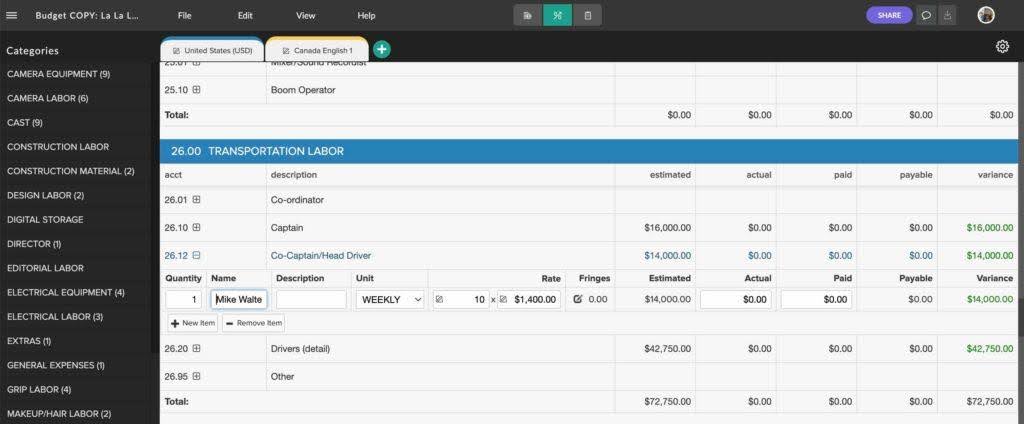
Find out more about the Celtx budgeting tools here.
Collaboration and Communication
Line producers live in communication hell. So Celtx can help by:
- Centralizing production documents
- Allowing controlled access for different departments
- Tracking updates and approvals
- Reducing version-control disasters
The software doesn’t replace judgment but removes friction. And friction is the enemy of a smooth shoot.
How to Become a Line Producer
Let’s be realistic, there is no shortcut to becoming a line producer, and anyone selling you any kind of shortcut is lying through their teeth.
Line producers are forged through exposure, repetition, and responsibility. Let’s explore the most realistic path:
How to Become a Line Producer in Film & TV
- Start in the Production Office
Most line producers begin as production assistants (PAs), assistant production coordinators or office PAs. It’s where they learn:
– How paperwork actually flows
– How departments communicate (or don’t)
– How schedules change in real time
– How mistakes cascade
– How to use production management software
If you treat these roles as ‘below you’, you’ll never learn how to be a good line producer. Embrace everything! - Move to UPM/Coordinator
The next step is proving you can manage systems and people. As a production coordinator or UPM, you’ll:
– Run the production office
– Manage crew logistics
– Coordinate vendors and unions
– Solve problems under pressure
– Learn how decisions affect morale and cost
This is where you earn trust which is the most valuable currency in production. - Master the Budget
At the highest level, line producers are financial strategists. During this stage, you’ll learn:
– Industry-standard budgeting software
– Union agreements and fringes
– Tax incentives and rebates
– Contingency planning
– Cost reporting and forecasting
A line producer who doesn’t understand money is just a stressed-out assistant with authority. Don’t be that person.
Common Mistakes to Avoid
Even experienced professionals can fall into traps, so keep in mind these pitfalls:
Overlooking Insurance
Insurance is vital to protecting your production. Failing to account for errors and omissions, workers’ compensation, equipment coverage, and location requirements can shut down a production before you can say ‘cut!’
Mismanaging Contingencies
Remember, contingency funds are not ‘extra money’. They are already spent, just not yet identified. So as a line producer, don’t use contingency for convenience instead of necessity. This is how productions collapse late in their schedule.
Trying to be the Hero
A line producer who hides problems instead of addressing them early will eventually face a disaster they can’t fix. While transparency builds solutions, ego can build fires… destructive ones!
FAQs About the Role of Line Producer
Yes. In fact, television often relies even more heavily on strong line producers due to compressed schedules and long seasons.
Absolutely, but their creativity is applied to problem-solving, logistics, and execution rather than story or performance.
They are well-compensated at higher levels, especially on studio and network projects. But they earn it through responsibility and risk.
A line producer makes on average $92,000 for $45 per hour in the United States.
Want more specifics? You can find them here with Americans for the Arts.
Yes, and they must. Their job is to protect the production, not indulge every idea.
Conclusion
A line producer is not just a manager. They are not just a budget watchdog. And they are certainly not “the person who says no.”
They are the person who says:
- Here’s how we can make this work.
- Here’s what it will cost.
- Here’s what we have to give up to get it.
They are the adult in the room ensuring that creativity survives contact with reality. And if you ever work on a production where everything runs smoothly, people feel respected, and the film actually gets finished on time? Thank the line producer. They already planned for everything you didn’t see.
Focus on your story, not your formatting.
Let Celtx’s Script Editor automatically apply all industry rules while you focus on the story.
Up Next:

Producer vs Director: Roles, Responsibilities & 5 Key Differences
Producers and directors work closely, but their responsibilities are very different. This breakdown explains who does what on set and how the roles collaborate throughout a production.