If you’re reading this, chances are you’re either about to dive into your very first screenplay wide-eyed, caffeinated, and ready to bring your story to life. Or you’re somewhere deep in the trenches of a production pipeline wondering why your current writing tool suddenly feels like it’s working against you. Maybe you’re juggling drafts, passing PDFs back and forth, or discovering that the “collaboration” feature you were promised is more of a polite suggestion than a usable workflow.
Either way, you’ve arrived at a very common crossroads in the filmmaking world: Celtx vs. WriterDuet. These two platforms are practically household names for screenwriters and small productions. Both promise smooth collaboration, intuitive tools, and a more enjoyable writing experience. Both have legitimate fanbases. And both claim to make your creative life easier.
But here’s the real question: Which one is actually the best collaborative script tool? And even more importantly: Which one fits the way you work, your process, your team, your production style, your budget, and your goals?
Because not all collaboration is created equal. Some writers just need clean, real-time co-writing. Others need a tool that carries a script from the blank page all the way to a shooting schedule and a call sheet.
So, in today’s blog, we’re breaking down the true strengths of Celtx and WriterDuet and helping you figure out exactly which screenwriting tool is right for you, your workflow, and the future of your project. Let’s get into it.

What to Look for in Collaborative Screenwriting Software
Collaboration means more than just typing words at the same time. A true collaborative screenwriting platform should:
- Keep writers coordinated without constant emailing of draft versions.
- Organize notes, comments, and revisions in a way that’s intuitive.
- Offer a workspace where multiple team members such as writers, producers, and directors, can contribute without stepping on each other’s toes.
- Support the entire ecosystem of a project, not just the script.
WriterDuet and Celtx both check some of these boxes. But Celtx, as you’ll see later, goes beyond the script itself, extending into breakdowns, scheduling, call sheets, budgeting, and even pre-production workflows that WriterDuet simply doesn’t cover.
Let’s dive in a little deeper…
Core Feature Showdown: Celtx vs. WriterDuet
First, let’s compare the heavy hitters: collaboration, script breakdown, workflow integration, and pricing.
1. Collaboration
If this were merely a typing competition, WriterDuet might walk away with the crown. For years, WriterDuet has been known as one of the smoothest real-time collaborative writing experiences around. Its live co-writing, inline comments, revision tracking, and Google Docs-like responsiveness are genuinely excellent. It’s clean, fast, and almost never gets in your way.
But here’s where the conversation pivots:
Celtx offers more with its shared projects. Here’s the difference:
WriterDuet
- Great for teaming up on a script
- Real-time sync, comments, and history
- A focused writing tool with collaboration built into the page
Celtx
- A shared, cloud-based hub where the entire production can collaborate
- Writers, directors, producers, ADs, and other team members work in the same ecosystem
- Notes, changes, breakdowns, schedules, and script updates all sync inside one platform
This distinction really matters. If your project has multiple departments, Celtx keeps everyone aligned without exporting files, re-uploading PDFs, or maintaining separate tools for script vs. production.
While WriterDuet is collaborative writing, Celtx is collaborative filmmaking. If you want the whole team working together, then Celtx takes the lead.
2. Script Breakdown
And here is where we really roll up our sleeves and say, “Alright, let’s get serious.”
WriterDuet
WriterDuet focuses on writing. If you want to break down a script into:
- Characters
- Props
- Locations
- Wardrobe
- FX
- Set pieces
- And so on…
…you need additional software.
That means exporting to another program (like StudioBinder or Movie Magic), reformatting, tagging manually, and juggling multiple tools. Nothing kills production management flow faster than chasing file compatibility across platforms.
Celtx
And with Celtx:
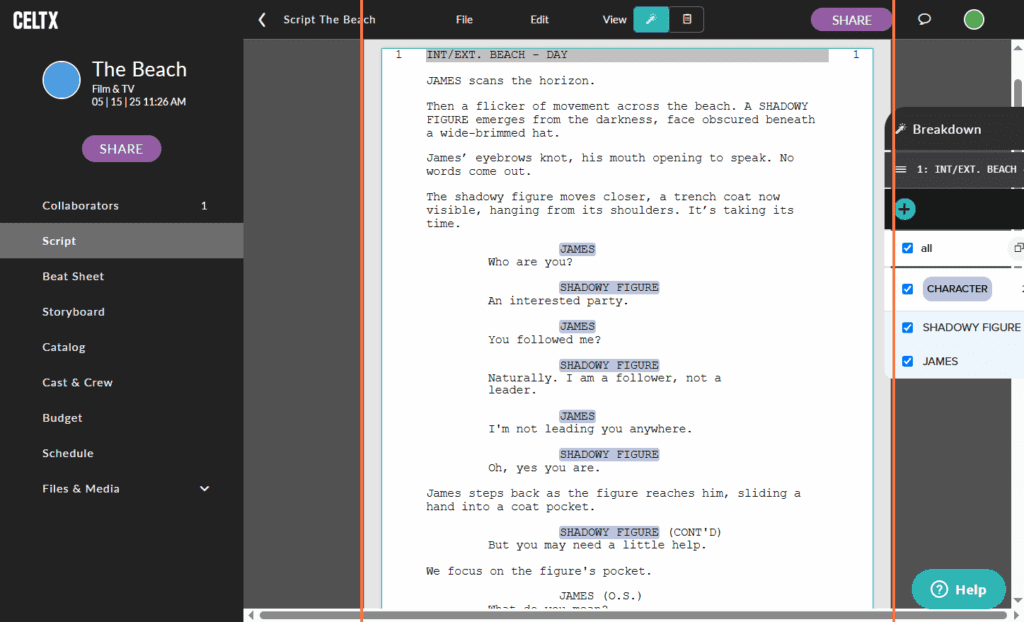
- You highlight elements directly in the script.
- They populate the breakdown dashboard instantly.
- The breakdown connects automatically to scheduling, budgeting, and call sheets.
- Multiple team members can collaborate on breakdown categories in real time.
Think of it as more of a lifecycle approach: what you write becomes what you shoot, with zero duplication of effort, giving you a massive advantage when it comes to your production.
3. Workflow Integration
This is where Celtx absolutely pulls ahead by a mile with wind resistance, while carrying a clipboard and wearing a headset.
WriterDuet
WriterDuet is laser-focused on one task: writing scripts collaboratively and professionally. It does that extremely well, but the workflow does end there.
If you need:
- A shooting schedule
- Stripboards
- Call sheets
- Budgeting tools
- Shot lists
- Asset management
- Production calendars
…you’re back to stacking additional platforms. Of course, there’s nothing wrong with that if your goal is just to write.
But what if you’re planning to shoot? Well…
Celtx
Celtx provides an integral production suite, including:
- Master project dashboard
- Script editor
- Script breakdown
- Shot lists & storyboarding
- Scheduling
- Call sheets
- Budgeting
And the best part is, all these tools are connected.
When you tag a prop in a scene, it appears automatically in many production elements:
- Your breakdown
- Your production catalog
- Your schedule
- And ultimately your call sheets
This is the kind of automation that saves producers days on a project. As a full pre-production environment, Celtx is the ideal choice in a world filled with spreadsheets and frantic re-edit.

Start collaborating instantly. Try Celtx’s real-time collaborative script editor for free today.
4. Accessibility & Pricing
Both Celtx and WriterDuet offer free tiers, but they serve very different purposes.
WriterDuet (Free Plan)
WriterDuet is:
- Very generous for writers
- Unlimited collaborators for some features
- Limited to a few projects in total
- Most advanced features require paid plans
Which is ideal for:
- Students
- First-time writers
- Writers collaborating purely on words, not production
Celtx (Free Plan)
Whereas Celtx offers:
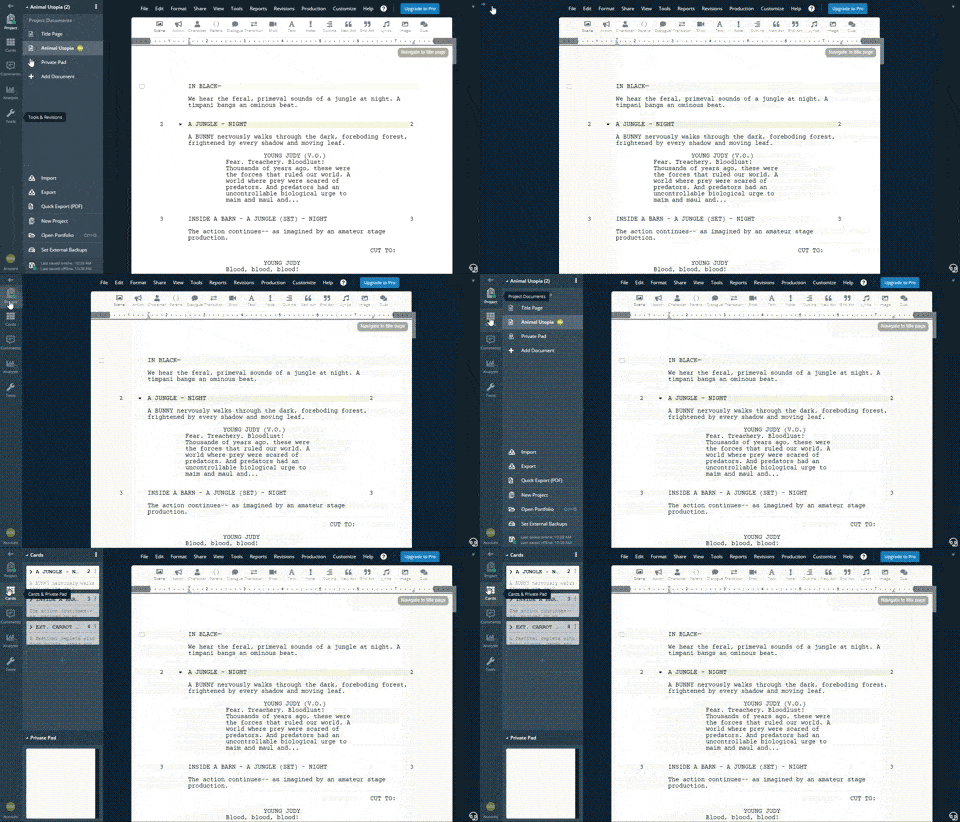
- Intuitive script tools
- A great way to try full pre-production suite
- Multiple features allowing you to hit the ground running.
So, how do these stack up to the paid plans?
WriterDuet (Paid Plan)
Here, you’re paying for premium writing tools and collaboration features. It’s affordable, especially for writers not handling production responsibilities.
Celtx (Paid Plan)
On the other hand, with Celtx you’re paying for an entire production pipeline including writing, breakdowns, scheduling, budgeting, and team workflow tools.
Which is cheaper for a full feature film project? Well, it’s Celtx hands down. Why? Well, because WriterDuet would require separate apps for scheduling, call sheets, shot lists, and budgeting, each with their own subscriptions. Celtx consolidates all of that in one place.
Feature Comparison Table: Celtx vs. WriterDuet
| Feature | Celtx | WriterDuet |
| Primary Purpose | Full script-to-production platform | Collaborative screenwriting app |
| Real-Time Collaboration | Yes (across entire project ecosystem) | Yes (industry-leading real-time writing) |
| Could-Based Project Workspace | Yes (shared projects for writers and production teams) | Limited to script collaboration only |
| Script Writing Tools | Professional screenplay editor | Professional screenplay editor |
| Revision Tracking | Yes | Yes (very advanced and granular controls) |
| Script Breakdown (Integrated) | Yes (built-in, automatic tagging) | No (requires internal software) |
| Scheduling/Stripboards | Yes (built-in production scheduling) | No |
| Call Sheets | Yes (auto generated from script and schedule) | No |
| Budgeting Tools | Yes (production budgeting included) | No |
| Shot Lists/Storyboarding | Yes | No |
| Production Catalog/Asset Management | Yes | No |
But most importantly, both Celtx and WriterDuet follow The Writers Guild Guide for Script Formatting, so you know you can rely on both tools’ formatting automations.
The Celtx Advantage: Full Lifecycle Project Management
Here’s the big-picture truth:
WriterDuet is a fantastic writing tool. Celtx is a writing tool plus a production management ecosystem.
If your goal is simply to write scripts, especially collaboratively, WriterDuet might be all you need. It’s smooth, clean, lightweight, and excellent at what it does.
But once the script leaves the page and enters pre-production, WriterDuet bows out. Celtx steps in with a full suite of tools designed for:
- Indie filmmakers
- Film school teams
- Small production houses
- Content creators scaling up
- Producers and ADs who need real, usable production outputs
Celtx is built for the entire journey of a screenplay from blank page to locked script to shooting schedule to call sheets to budget tracking.
If your project will ever move beyond the writing phase, Celtx becomes the practical choice. It’s a single, organized, collaborative home that keeps writers, producers, and crew aligned.

Want to find out how Celtx stacks up against other screenwriting software? Check out our dedicated blogs below:
Celtx vs. Final Draft | Features, Pros, and Pricing
Celtx vs. StudioBinder: Which Production Management Software is Right for Your Workflow?
Frequently Asked Questions (FAQs)
If you’re purely writing and learning the craft, WriterDuet might feel more approachable thanks to its simplicity and lower-cost writing plans.
If you’re learning filmmaking as well, or you want to explore professional production workflows early, Celtx offers a better “big picture” experience.
Not really. WriterDuet focuses almost entirely on writing and collaboration. You’ll need separate tools for breakdowns, scheduling, call sheets, and budgeting.
Yes. Export your Celtx script to .fountain, .fdx, or .pdf and import into WriterDuet. Just remember breakdowns and production data won’t transfer, only the script text.
Celtx, because:
– Scheduling is included
– Call sheets are included
– Budgeting is included
– Breakdown tools are included
With WriterDuet, you’d need to subscribe to multiple third-party platforms to match Celtx’s production capabilities.
Conclusion: Which Screenwriting Software is Right for You?
Choosing between Celtx and WriterDuet comes down to one foundational question:
Are you writing a script… or are you making a film?
If you’re a writer whose project will stay on the page, WriterDuet is an excellent, focused choice. It’s one of the best collaborative writing tools ever built. But if your script is headed toward production, even on a small scale, Celtx becomes the smarter, more efficient, more future-proof platform.
Celtx isn’t just a collaborative writing app. It’s a collaborative ecosystem for filmmaking. Your script doesn’t live in isolation, and Celtx treats it that way.
Focus on your story, not your formatting.
Let Celtx’s Script Editor automatically apply all industry rules while you focus on the story.
Continue Your Research:
Best Free Screenwriting Software
Not ready to commit to a subscription? Explore the top free screenwriting tools — what they offer, where they fall short, and how to choose the right fit for your next script.